A growing body of consumer research reveals that viewers are increasingly gravitating toward free ad-supported streaming TV (FAST) channels, though paid subscription video on demand (SVOD) services still command a larger share of total viewing time. The shift is driven primarily by subscription fatigue, rising costs, and the improving quality of free platforms. As of 2025, 62% of consumers prefer free, ad-supported streaming over paid subscriptions, while 81% say watching ads is a fair trade-off for free content. However, paid streaming still holds approximately 19% of total TV viewing compared to FAST’s 5.7%, indicating that while preference is tilting free, actual viewing behavior reflects a hybrid approach where most households use both.
The Rise of FAST: Market Growth and Viewership
Explosive Growth Trajectory
FAST has evolved from a niche experiment into one of streaming’s most dynamic growth engines. The global FAST market was valued at approximately $9.73 billion in 2024 and is projected to reach $40.20 billion by 2033, growing at a compound annual growth rate (CAGR) of 16.9%. More recent estimates place the market at $10.6 billion in 2025 and $12.23 billion in 2026, with projections exceeding $41 billion by 2035.
U.S. viewers streamed 1.8 billion hours of FAST content through August 2025, a 43% increase from 1.3 billion hours during the same period in 2024. The number of monthly active households watching FAST channels grew 12% in 2025, while average daily viewing hours per household climbed 16%, producing a combined 29% increase in total viewing time across platforms.
Channel Proliferation
The FAST channel landscape has expanded dramatically — from roughly 100 channels in the U.S. in 2019 to approximately 1,900 channels globally by 2025, a 76% increase since 2023. Samsung TV Plus alone hosts over 3,500 channels worldwide. Sports channels surged 105% between mid-2024 and February 2025, while reality TV channels grew an astonishing 626% in less than a year.
Viewing Share vs. Paid Streaming
While FAST is growing rapidly, paid streaming still holds a larger share of total viewing time. According to Nielsen’s Gauge data from May 2025:
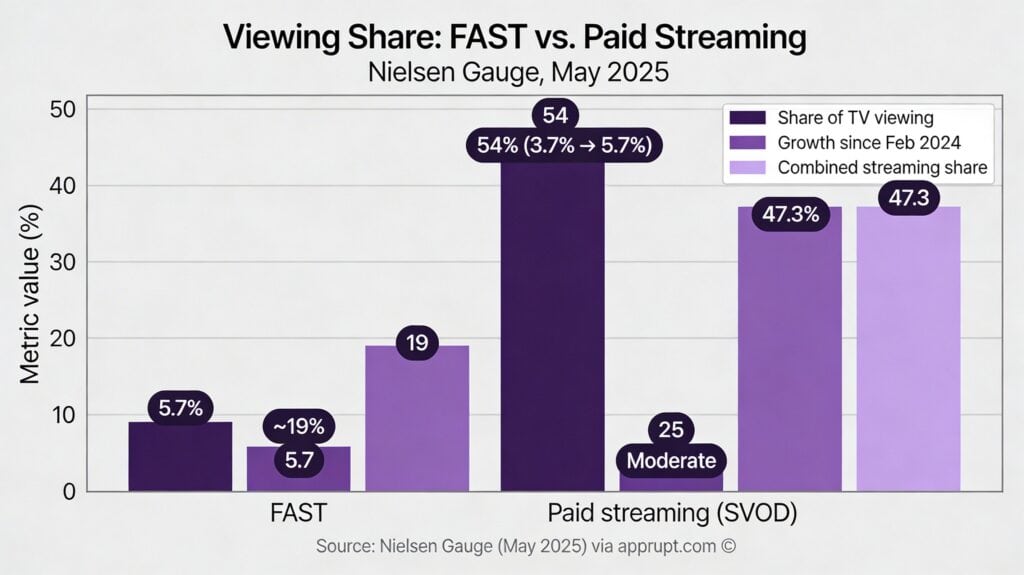
| Metric | FAST | Paid Streaming (SVOD) |
| Share of total TV viewing | 5.7% | ~19% |
| Growth (Feb 2024 → May 2025) | 54% (3.7% → 5.7%) | Moderate |
| Combined streaming share | 47.3% of total TV | — |
Notably, the combined FAST viewing share of Pluto TV, Roku Channel, and Tubi (5.7%) now exceeds the individual viewing share of any single broadcast network like NBC, CBS, or ABC. The Roku Channel (2.8% of total viewership) and Tubi (2.1%) individually outperform paid services like Paramount+ (2.0%), Peacock (1.4%), and HBO Max (1.3%).
What Consumer Surveys Reveal About Preferences
Strong Preference for Free Content
Multiple surveys confirm a clear consumer tilt toward free, ad-supported options:
- 62% of consumers prefer free, ad-supported streaming over paid subscriptions, according to The Stream 2024 report sponsored by Tubi.
- 66% of U.S. TV viewers use FAST platforms in a typical month, per Horowitz Research.
- 47% of U.S. households actively engage with FAST on a weekly basis, according to Wurl data.
- 53% of FAST users say they have cut down on paid streaming services after adopting FAST.
- 73% of FAST users agree that TV is more enjoyable now that they can turn on free services and watch whatever is on.
The Ad Tolerance Trade-Off
Consumer attitudes toward advertising reveal a nuanced picture. According to The Stream 2025 report from Tubi and The Harris Poll:
- 79% of consumers expect no ads at all if they are paying for a streaming service.
- 81% say watching ads is a fair trade-off for access to free streaming content.
- ~80% of consumers on paid services feel that ad breaks are unwelcome when they are already paying.
This data underscores a clear consumer principle: ads are acceptable when content is free, but feel like a betrayal when paired with a subscription fee. As paid streaming services increasingly introduce ad-supported tiers at lower price points, this tension is becoming a strategic challenge for platforms like Netflix, Disney+, and Max.
Subscription Fatigue Is Driving the Shift
Rising costs and an overabundance of streaming options are pushing consumers toward free alternatives:
- 41% of paid video streamers have canceled at least one service due to subscription fatigue, matching the highest point in 2025.
- 66% of Americans cite cost as the primary reason for canceling a streaming service.
- 74% consider cost the most important factor when choosing a new streaming service.
- 59% of households are worried about annual streaming price increases, and 58% believe those hikes are unfair and unreasonable.
- 42% feel they have too many streaming subscriptions.
- The average American streamer now spends $129 per month combined on streaming services and paid TV subscriptions.
The number of SVOD subscriptions per U.S. household dropped more than 10% — from approaching 3.5 in April 2023 to under 3 by November 2023 — as FAST adoption accelerated.
Demographic Patterns: Who Prefers What?
Older Viewers Lead FAST Adoption
One of the most notable demographic trends is the dominance of older viewers in the FAST space. According to Nielsen data presented at CIMM West 2025, Americans aged 50–64 are the most avid FAST viewers, watching more FAST content than any other age group. Viewers 50 and older now spend more time on FAST platforms than on Netflix — a shift that first occurred in spring 2024 and has held steady since.
Gen Z: High Engagement, High Churn
Gen Z presents a paradox — they are highly engaged with streaming but also the most susceptible to subscription fatigue:
- 37% of Gen Z streaming subscribers canceled at least one service since December 2025 due to feeling overwhelmed.
- 52% of Gen Z streamers use ad-supported tiers as of mid-January 2026.
- 76% of Gen Z indicated they have or would cancel a streaming subscription due to a price hike.
- 8 in 10 Gen Z viewers have signed up for a streaming service to watch a specific show, then canceled or paused afterward — a significantly higher churn rate than older groups.
Gen Z viewers also show a strong affinity for original and indie content, with 70% saying they want to see more TV and movies from smaller or independent creators.
The Lean-Back Appeal
A key psychological driver of FAST adoption is the return of the “lean-back” viewing experience. Over 7 in 10 FAST users agree that TV is more enjoyable when they can simply turn on a free service and watch whatever is on. Among cord-cutters, 58% say free services feel like having cable TV again. This signals that many viewers missed the effortless channel-surfing experience that on-demand streaming replaced with decision fatigue.
The Hybrid Reality: Most Viewers Use Both
Despite strong preference signals for free content, the data reveals that most households are not choosing exclusively between FAST and paid streaming — they use both. FAST acts as a complement, not a replacement, for paid services in most cases.
- 43% of FAST users have subscribed to a paid service to continue watching a show they discovered on a FAST channel.
- Netflix’s ad-supported tier now accounts for 45% of its total U.S. household viewing hours, up from 34% in 2024.
- The share of U.S. households watching ad-supported content on Disney+ increased 16 percentage points year-over-year, Netflix climbed 11 points, and HBO Max rose 10 points.
This suggests the streaming landscape is converging toward a hybrid model where free and low-cost ad-supported tiers serve as the foundation, supplemented by one or two premium paid subscriptions for exclusive or original content.
India and Emerging Markets
FAST adoption is accelerating in emerging markets, with India emerging as a significant growth region. India’s connected TV user base has grown by approximately 87%, while nearly 91% of the population engages with advertisements while consuming content. Regional FAST channels with culturally relevant programming are gaining traction, as platforms like Swastik Stories reach approximately 50 million viewers across major connected TV platforms.
In Brazil, FAST revenues are projected to nearly triple from $119 million in 2024 to approximately $303 million by 2029, driven by viewer preference for free-to-air streaming channels. Europe captured around 17% of global FAST revenues in 2023, with projections to reach approximately 22% by 2029.
Platform Landscape
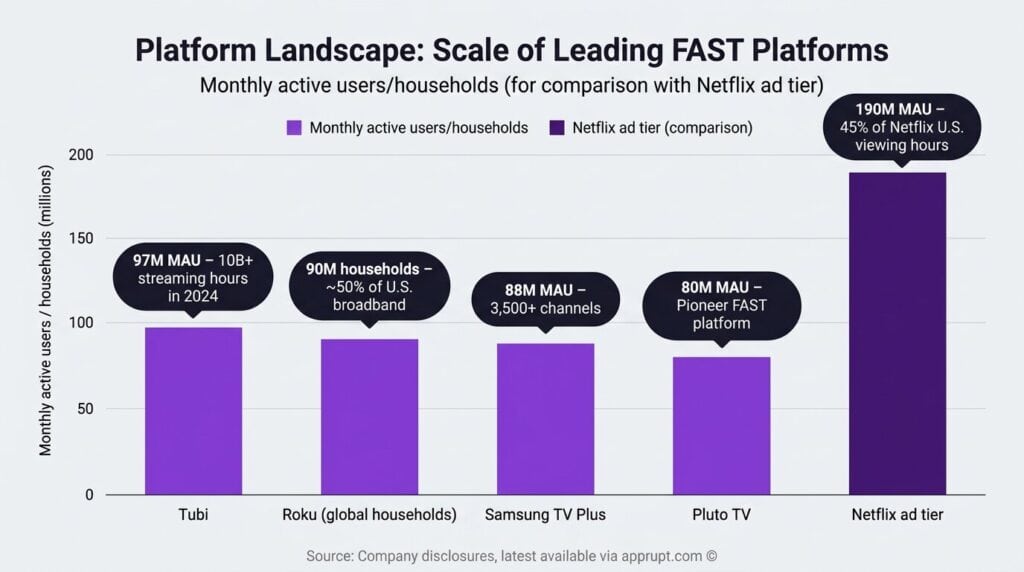
The leading FAST platforms have achieved scale that rivals or exceeds several paid streaming services:
| Platform | Monthly Active Users/Households | Key Stat |
| Tubi | 97 million MAU | 10B+ streaming hours in 2024 |
| Roku (global households) | 90 million | ~50% of U.S. broadband households |
| Samsung TV Plus | 88 million MAU | 3,500+ channels globally |
| Pluto TV | 80 million MAU (last reported May 2023) | Pioneer FAST platform |
| Netflix ad tier (for comparison) | 190 million MAV globally | 45% of Netflix U.S. viewing hours |
FAST platforms also offer a cost-efficiency advantage for advertisers, with CPMs averaging around $10–$20, compared to $30+ for major subscription streamers. Ad viewability on FAST platforms (74%) is within one percentage point of subscription services, and both share a 50% visual attention rate.
Why FAST Is Gaining Ground
Several structural factors are converging to drive FAST’s growth:
- Economic pressure: Combined streaming costs now exceed $100/month for many households, surpassing what cable once cost.
- Subscription fatigue: Consumers are reaching practical limits on how many services they can manage and afford.
- Content quality improvement: FAST libraries now include recent content — nearly 50% of FAST programming was produced in the last 5 years, compared to roughly one-third on premium SVOD.
- Smart TV integration: Many smart TVs come with FAST services pre-installed, making access seamless and reducing friction.
- Live sports: Sports channels on FAST grew 105%, with marquee events like Super Bowl LIX streamed free on Tubi to 13.6 million viewers.
- Lean-back experience: FAST replicates the familiarity of linear TV with the flexibility of digital delivery, satisfying viewers who missed channel surfing.
Conclusion
Consumer preference is clearly tilting toward free, ad-supported streaming, with survey data consistently showing that a majority of viewers favor free content and find ads an acceptable trade-off. However, “preference” does not equal “exclusive use.” The streaming future is hybrid: most households will maintain one or two paid subscriptions for premium originals and live events while relying on FAST channels for everyday, lean-back viewing. The real winners in this landscape will be platforms that successfully blend both models — offering free content to attract audiences and premium tiers to monetize the most engaged viewers. For advertisers and content creators, FAST represents an increasingly essential channel that can no longer be treated as secondary to subscription services.
