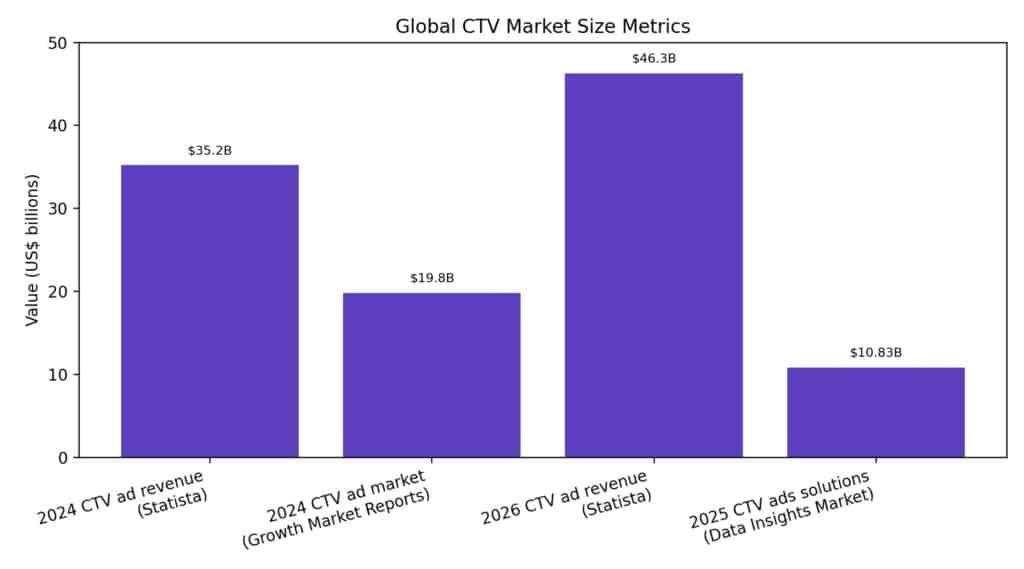
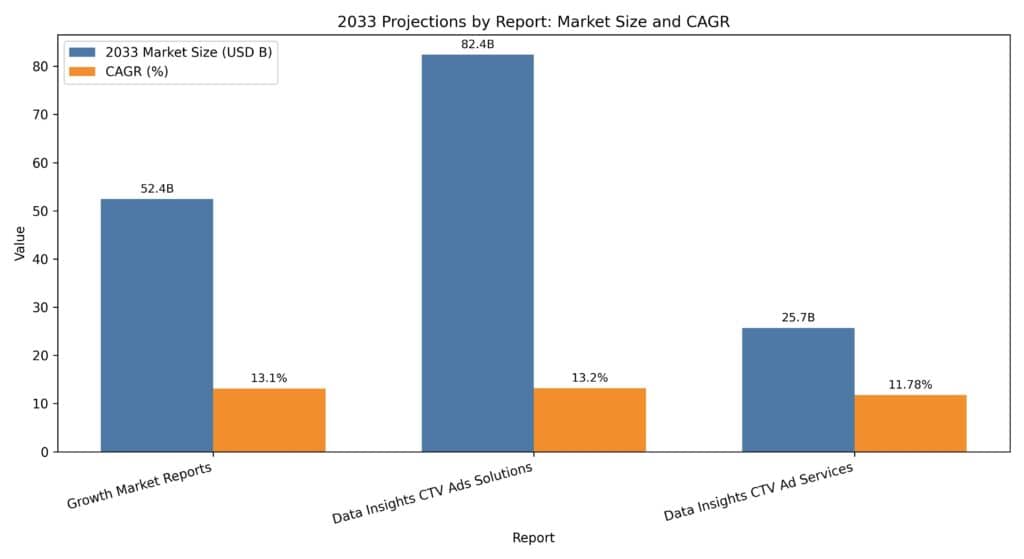
The global Connected TV (CTV) advertising market is on a rapid growth trajectory, fueled by accelerating cord-cutting, the maturation of ad-supported streaming tiers, and advances in programmatic buying and measurement. The market reached approximately $19.8–35.2 billion globally in 2024, depending on the scope of measurement (ad solutions vs. total ad revenue). By 2033, estimates range from $52.4 billion to $82.4 billion, with a compound annual growth rate (CAGR) of 11–13%. In the United States alone — the world’s largest CTV market — ad spending hit $33.35 billion in 2025 and is projected to reach approximately $38 billion in 2026, with CTV on course to surpass traditional TV advertising by 2028.
Global Market Size and Forecast
Current Valuation
Multiple research firms provide overlapping but scope-dependent estimates of the global CTV advertising market:
| Metric | Value | Source |
| Global CTV ad revenue (2024) | $35.2B | Statista |
| Global CTV advertising market (2024) | $19.8B | Growth Market Reports |
| Global CTV ad revenue (2026 forecast) | $46.3B | Statista |
| CTV ads solutions market (2025) | $10.83B | Data Insights Market |
The variation reflects differences in scope — some estimates cover total CTV ad revenue globally (including platform and programmatic spend), while others focus specifically on CTV ad solutions or services. Statista’s broader measure of $35.2 billion in 2024 encompasses the full CTV ad revenue pie, whereas ad solutions-specific reports track a narrower segment.
2033 Projections
| Report | 2033 Market Size | CAGR | Base Year |
| Growth Market Reports | $52.4B | 13.1% | 2024 |
| Data Insights Market (CTV Ads Solutions) | $82.4B | 13.2% | 2025 |
| Data Insights Market (CTV Ad Services) | $25.7B | 11.78% | 2025 |
Growth Market Reports projects the Connected TV Advertising market to reach $52.4 billion by 2033 at a 13.1% CAGR, driven by cord-cutting, streaming adoption, and advances in ad targeting. Data Insights Market’s broader CTV Ads Solutions estimate reaches $82.4 billion by 2033 at a 13.2% CAGR. Meanwhile, CTV is projected to command over 40% of global ad spending by 2030, according to WARC, as linear TV’s share has already dropped to just 12%.
U.S. Market: The Dominant Force
The United States accounts for the largest share of global CTV ad spending and offers the most granular forecast data.
Year-by-Year U.S. CTV Ad Spend Trajectory
| Year | U.S. CTV Ad Spend | YoY Growth | Source |
| 2024 | $28.79B | — | Statista |
| 2025 | $33.35B | ~16.8% | eMarketer |
| 2026 | ~$38B | ~14% | eMarketer |
| 2028 | $46.89B | — | MNTN Research |
| 2029 | $51B | ~11% | eMarketer |
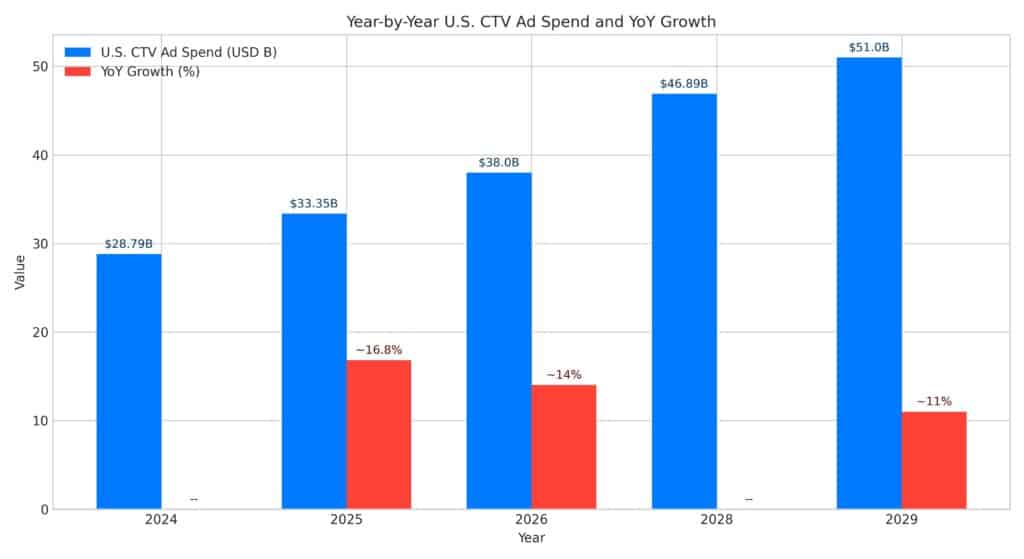
CTV ad spending in the U.S. reached $33.35 billion in 2025, marking roughly 16.8% year-over-year growth. By 2026, the market is expected to grow approximately 14% to reach $37.95–$38 billion. Growth rates are projected to ease from 14% in 2026 to around 11% by 2029, but the absolute dollar gains remain substantial — nearly $20 billion in new U.S. ad spend is anticipated over five years. By 2028, CTV is expected to surpass traditional TV advertising for the first time in history.
Market Structure and Key Players
The U.S. CTV advertising market is consolidating around three dominant players. In 2026, YouTube is expected to account for nearly 12% of CTV ad revenues, driven by approximately $9.21 billion in net ad sales. Amazon and Disney (combining Hulu, Disney+, and ESPN) will each capture over 10% of the market. These three companies alone are projected to control roughly one-third of all CTV advertising.
Netflix’s ad tier exceeded $1.5 billion in revenue in 2025 and is expected to double in 2026. Amazon Prime Video’s ad tier, launched in January 2024, now reaches the vast majority of Prime subscribers. Disney+ continues to expand its 157 million ad-supported viewers globally.
Regional Market Analysis
Asia Pacific
The Asia Pacific CTV ads solutions market was valued at $10.5 billion in 2024 and is projected to reach $30.5 billion by 2033, growing at a CAGR of 12.5%. The region represents the fastest-growing market globally, driven by rising smart TV penetration, expanding middle-class populations, and increasing internet access across China, India, Japan, and Southeast Asia.
India
India’s CTV advertising market is at an inflection point. CTV ad revenue grew from INR 450 crore in 2022 to INR 1,500 crore in 2024 and is projected to reach INR 3,500 crore by 2027. WPP Media’s This Year Next Year report forecasts CTV ad revenue growing 20% in 2025 and 22% in 2026, reaching roughly USD 760 million and just under USD 1 billion (approximately Rs 6,800–8,000 crore) respectively.
CTV’s share of India’s total TV/professional video ad spend is expected to rise from 12% in 2024 to 14% in 2025 and 17% in 2026. By 2027, CTV could account for 42% of total TV ad spend in India. In 2026, CTV is anticipated to surge by another third, reaching approximately ₹8,000 crore. India’s total advertising market is projected to grow 9.7% in 2026 to Rs 2.0 trillion, with CTV and retail media as the most significant growth contributors.
North America and Europe
North America leads globally due to high CTV device penetration and the presence of major streaming platforms. Europe is growing steadily, with programmatic ad views in CTV rising 44% year-over-year and overall CTV ad views increasing 31% year-over-year in the region during the first half of 2025.
Key Growth Drivers
Cord-Cutting and Streaming Dominance
Streaming captured a record 47.5% of all U.S. TV viewing in December 2025, according to Nielsen. CTV already accounts for nearly 50% of total viewing time globally. Each percentage point of viewing share shifting from linear to streaming represents billions in advertising opportunity.
Ad-Supported Tier Maturation
The proliferation of ad-supported streaming tiers from major platforms — Netflix, Disney+, Amazon Prime Video, Peacock — has created vast new ad inventory. In 2026, 84.7% of subscription-based OTT ad sales are expected to originate from CTV, totaling $16.23 billion across all devices in the U.S..
Programmatic Buying
Programmatic purchasing is expected to account for 50% of CTV/OTT advertising in 2026. This has lowered barriers to entry, opening CTV to smaller advertisers who were previously confined to social and search channels. Programmatic ad views grew 29% year-over-year in the U.S. and 44% in Europe, now representing 30% of ad delivery in the U.S. premium video ecosystem.
Retail Media Integration
Retail media networks represent an emerging force within CTV. Ad sales from retail media on connected TV are expected to grow from $4.99 billion in 2025 to $10.28 billion by 2028 — more than doubling in three years. By 2027, one in five CTV ad dollars is projected to go to retail media. This convergence of commerce and television advertising is a structural shift in how brands activate performance-driven campaigns.
AI-Driven Personalization and Measurement
AI-driven personalization is projected to power 80% of CTV ads by 2027. Better measurement capabilities are driving advertiser confidence, with 70% of CTV advertisers planning to boost spending in 2026. Advanced targeting, real-time measurement, and improved attribution are key factors differentiating CTV from traditional TV.
Broader TV Advertising Context
The overall TV advertising market (including both linear and CTV) provides context for CTV’s growing share. The global TV advertising market was valued at approximately $145 billion in 2026 and is projected to reach $179 billion by 2030 at a 5.4% CAGR. The broader television advertising market, including all formats, could reach $329.9 billion by 2033 at a 3.24% CAGR. Within this, CTV is the clear growth engine while linear TV continues to decline.
Forecast Considerations
Several factors could influence these projections:
- Measurement standardization: The lack of unified cross-platform measurement standards remains a challenge, though improvements are ongoing.
- Ad fraud and brand safety: Four out of ten U.S. marketers cite brand safety as a CTV concern, and ad fraud in CTV remains an industry issue.
- Economic headwinds: While CTV spending is resilient, broader economic uncertainty could moderate growth rates, particularly in discretionary ad budgets.
- Privacy regulations: Data privacy rules like GDPR in Europe and evolving U.S. state-level privacy laws may constrain some targeting capabilities.
- Market concentration: With just three companies controlling roughly a third of U.S. CTV advertising, pricing power dynamics and market access for smaller publishers warrant monitoring.
Conclusion
The CTV advertising market is transitioning from a high-growth disruptor to a mainstream advertising pillar. Global projections point to a market between $52–82 billion by 2033, with a CAGR of 11–13%. The U.S. market will grow from $38 billion in 2026 to an estimated $51 billion by 2029, surpassing traditional TV by 2028. Asia Pacific — particularly India — represents the fastest-growing regional opportunity, while programmatic buying, retail media integration, and AI-powered personalization serve as the structural drivers sustaining double-digit growth through the forecast period.
