FAST (Free Ad-Supported Streaming TV) viewership has surged into the mainstream. U.S. viewers streamed 1.8 billion hours of FAST content through August 2025, a 43% year-over-year increase. Today, 64% of U.S. homes watch FAST content, 47% tune in weekly, and FAST has become the #1 source for live TV viewing—surpassing cable/satellite for the first time.
By 2026, FAST viewership is projected to exceed 120 million annual viewers in the U.S. alone. The top three FAST services—Pluto TV, Roku Channel, and Tubi—collectively captured 5.7% of total U.S. TV viewing in May 2025, more than any individual broadcast network.
Platform-level metrics are equally striking: Tubi surpassed 100 million monthly active users (MAU), Samsung TV Plus crossed 100 million global MAU, and Roku is approaching 100 million streaming households. Viewership growth is being fueled by cord-cutting acceleration, subscription fatigue, smart TV penetration, and the expansion of premium content including live sports and local news on FAST platforms.
U.S. Viewing Hours & Growth
Total Hours Streamed
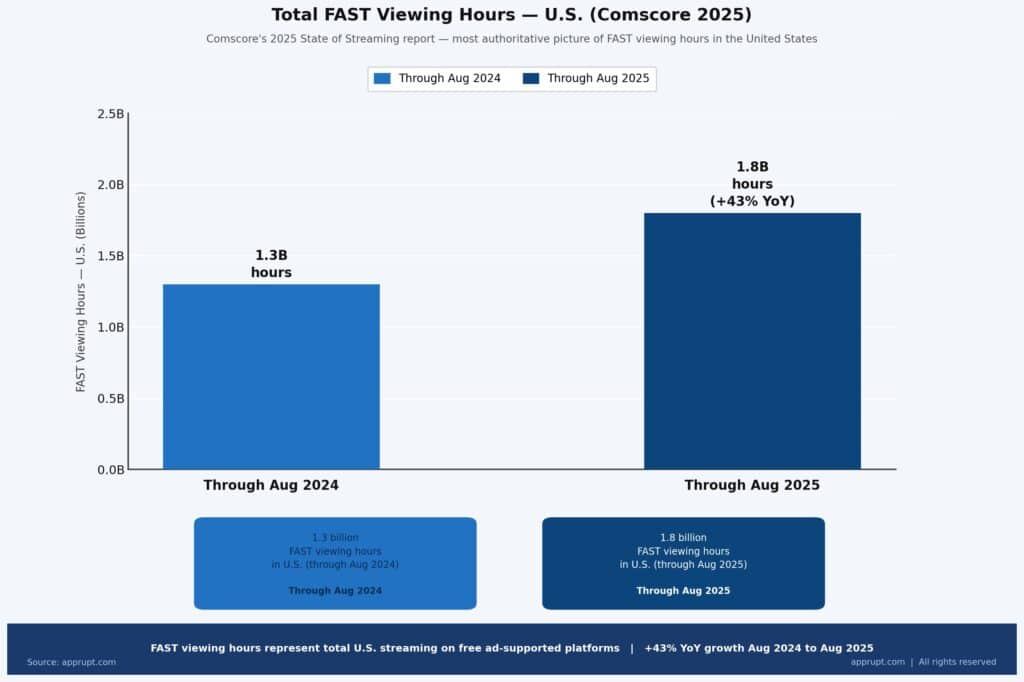
Comscore’s 2025 State of Streaming report provides the most authoritative picture of FAST viewing hours in the United States:
| Period | FAST Viewing Hours (U.S.) | YoY Change | Source |
| Through Aug 2024 | 1.3 billion hours | — | |
| Through Aug 2025 | 1.8 billion hours | +43% |
This 43% jump represents the sharpest annual increase in FAST viewing on record. Comscore characterized FAST channels as “one of streaming’s most dynamic growth engines,” noting that what began as a modern twist on traditional TV has evolved into a primary viewing destination.
Household-Level Engagement
Wurl’s 2025 CTV Trends Report, based on aggregated data across major FAST platforms from September 2024 through August 2025, provides granular household engagement metrics:
- Monthly active FAST households grew 12% year-over-year
- Average daily viewing hours per household climbed 16% YoY
- Total hours of viewing across ad-supported streaming channels surged 29% YoY when combining household growth and per-household increases
- Average FAST session duration increased 25% YoY
- Viewers spent 25% more time on a single channel before switching, indicating deepening engagement
- Most households concentrate their viewing across three to four channels on a given platform
CTV Household Reach
Connected TV streaming reached 96.4 million U.S. households overall (up 849,000 YoY), with the average household watching content from 6.9 streaming services. Total streaming time reached 13.9 billion hours, a 6% year-over-year increase across all platforms. Within this broader streaming ecosystem, FAST channels are growing at roughly 7x the rate of overall streaming.
U.S. Household Penetration
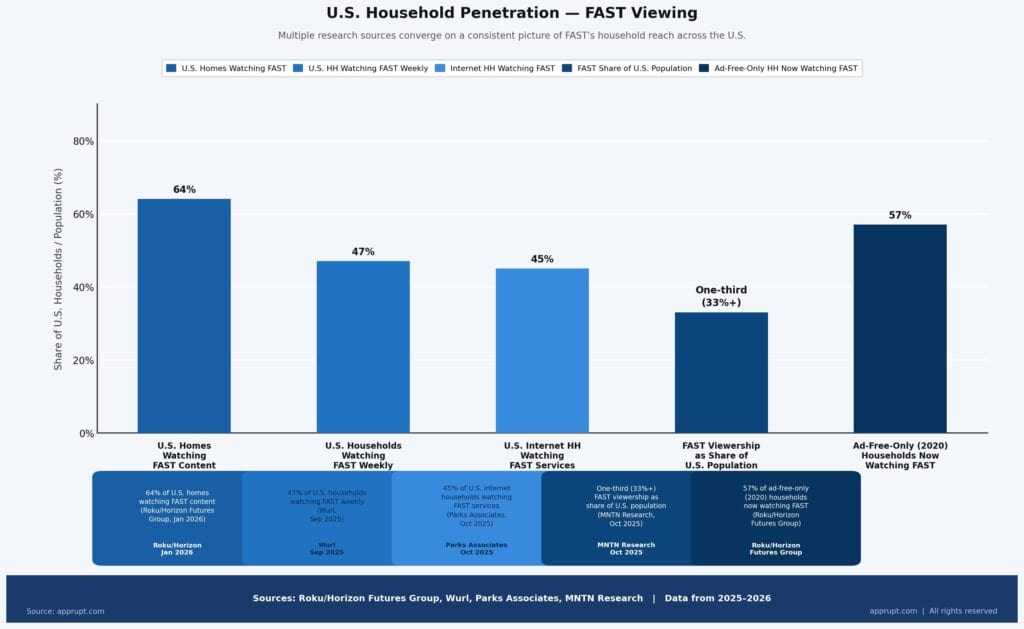
Multiple research sources converge on a consistent picture of FAST’s household reach:
| Metric | Value | Source |
| U.S. homes watching FAST content | 64% | Roku/Horizon Futures Group (Jan 2026) |
| U.S. households watching FAST weekly | 47% | Wurl (Sep 2025) |
| U.S. internet households watching FAST services | 45% | Parks Associates (Oct 2025) |
| FAST viewership as share of U.S. population | One-third (33%+) | MNTN Research (Oct 2025) |
| Ad-free-only (2020) households now watching FAST | 57% | Roku/Horizon Futures Group |
A notable finding from the Roku/Horizon Futures Group study: 57% of households that were streaming only ad-free content in 2020 have now adopted FAST. This stat directly illustrates how subscription fatigue and rising SVOD prices are driving migration toward free, ad-supported alternatives. Parks Associates also reported that 89% of U.S. internet households subscribe to at least one streaming service, meaning FAST is complementing—not replacing—paid streaming in most homes.
However, there are early signs of a plateau in new user acquisition. Parks Associates noted that FAST usage “dipped to 45% of households in Q1 2025” after a period of rapid growth, suggesting the sector may be transitioning from a user-acquisition phase to an engagement-deepening phase. Viewing hours per existing user, however, continue to climb sharply.
Share of Total TV Viewing
Nielsen’s The Gauge
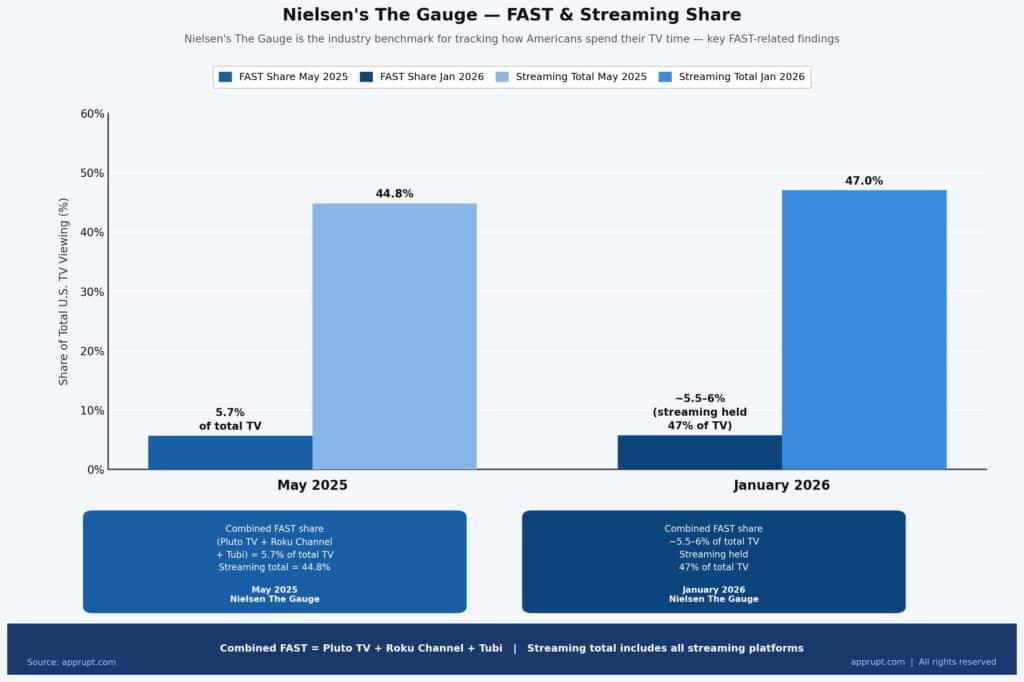
Nielsen’s monthly measurement report, The Gauge, is the industry benchmark for tracking how Americans spend their TV time. Key FAST-related findings:
| Month | Combined FAST Share (Pluto TV + Roku Channel + Tubi) | Streaming Total Share | Source |
| May 2025 | 5.7% of total TV | 44.8% | |
| January 2026 | ~5.5–6% (streaming held 47% of TV) | 47.0% |
The 5.7% combined share in May 2025 is larger than any individual broadcast network’s share during the same period. To put this in perspective, the top three FAST platforms grew their combined share from 3.1% to 5.7%—an 84% increase—in just one year.
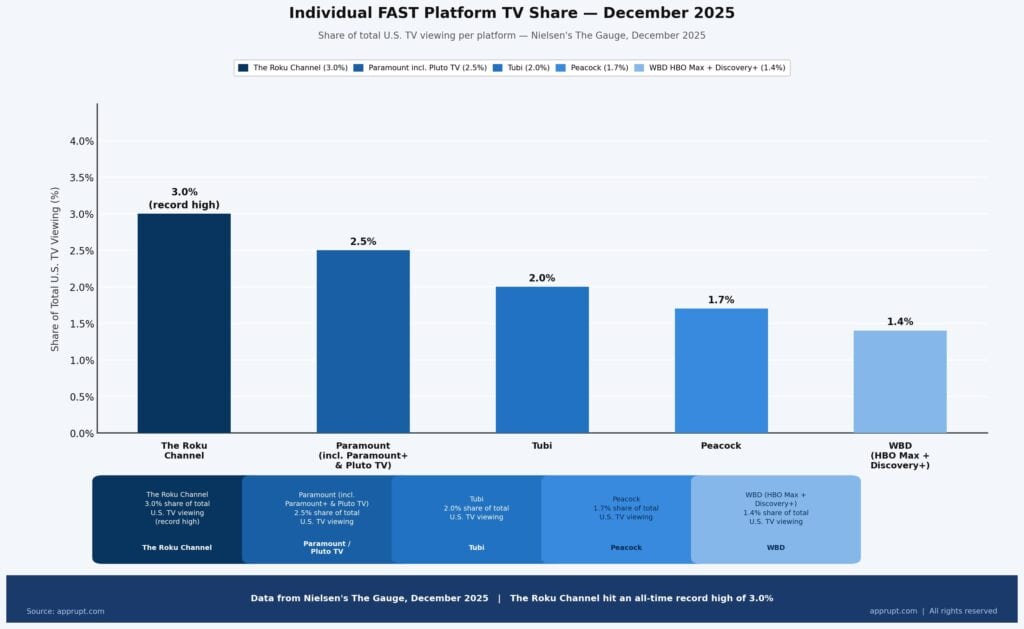
Individual FAST Platform TV Share (December 2025)
| Platform | Share of Total U.S. TV Viewing | Source |
| The Roku Channel | 3.0% (record high) | |
| Paramount (incl. Paramount+ & Pluto TV) | 2.5% | |
| Tubi | 2.0% | |
| Peacock | 1.7% | |
| WBD (HBO Max + Discovery+) | 1.4% |
The Roku Channel’s 3.0% share in December 2025 was unprecedented, surpassing Paramount (including Paramount+ and Pluto TV combined) and approaching Amazon Prime Video’s 4.3%. If all FAST viewership across all platforms were aggregated into a single app, it would rank as the fourth-largest on Roku by reach.
Streaming overall captured 47.5% of U.S. TV viewing in December 2025, its highest sustained level, with analysts projecting it will sustain over 50% by late 2026.
Viewership Projections (2026 & Beyond)
U.S. FAST Viewer Count
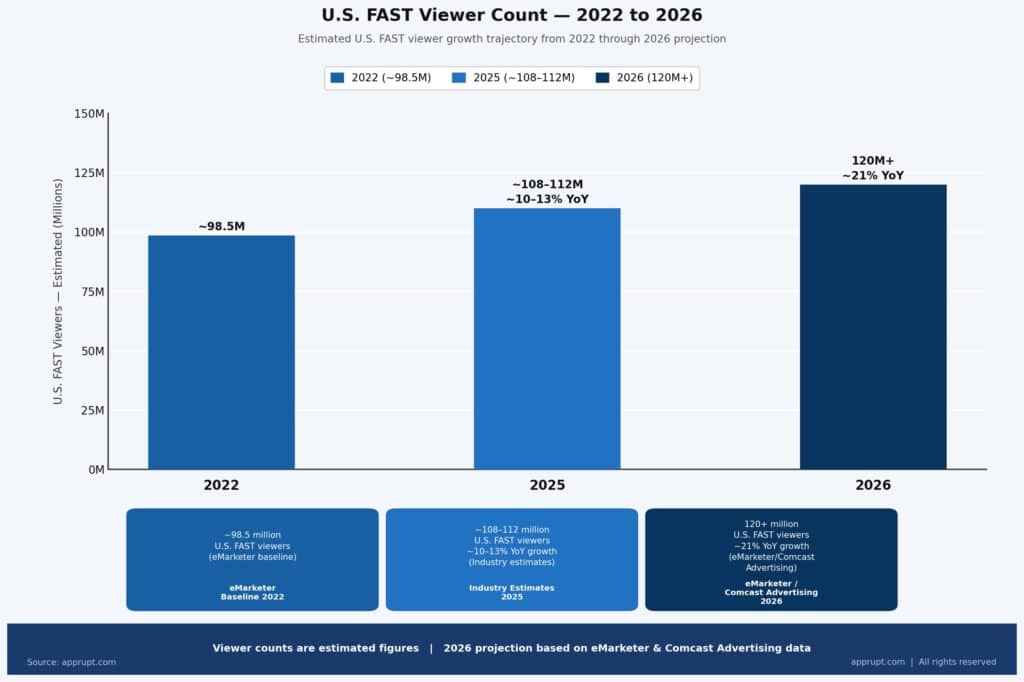
| Year | U.S. FAST Viewers (Est.) | YoY Growth | Source |
| 2022 | ~98.5 million | — | eMarketer baseline |
| 2025 | ~108–112 million | ~10–13% | Industry estimates |
| 2026 | 120+ million | ~21% | eMarketer/Comcast Advertising |
By 2026, FAST viewership is expected to exceed 120 million annual viewers in the U.S., representing approximately 62% of all AVOD viewers. This 21% increase reflects both new viewer acquisition and deeper penetration among existing streaming households. eMarketer’s research indicates FAST viewership will surpass 125 million in 2026.
Broader Streaming Context
The broader ad-supported streaming ecosystem is expanding rapidly alongside FAST:
- Netflix’s ad tier now reaches 190 million monthly active viewers globally, with 45% of U.S. Netflix household viewing hours occurring on the ad-supported plan (up from 34% one year prior)
- Ad-supported viewing increased by 16 percentage points on Disney+, 11 points on Netflix, and 10 points on HBO Max between August 2024 and August 2025
- Streaming exceeded combined broadcast + cable viewing for the first time in May 2025 (44.8% vs. 44.2%)
- YouTube alone captured 12.5% of all TV viewing in May 2025, up 120%+ since 2021
Platform-Level Viewership
Monthly Active Users by Platform
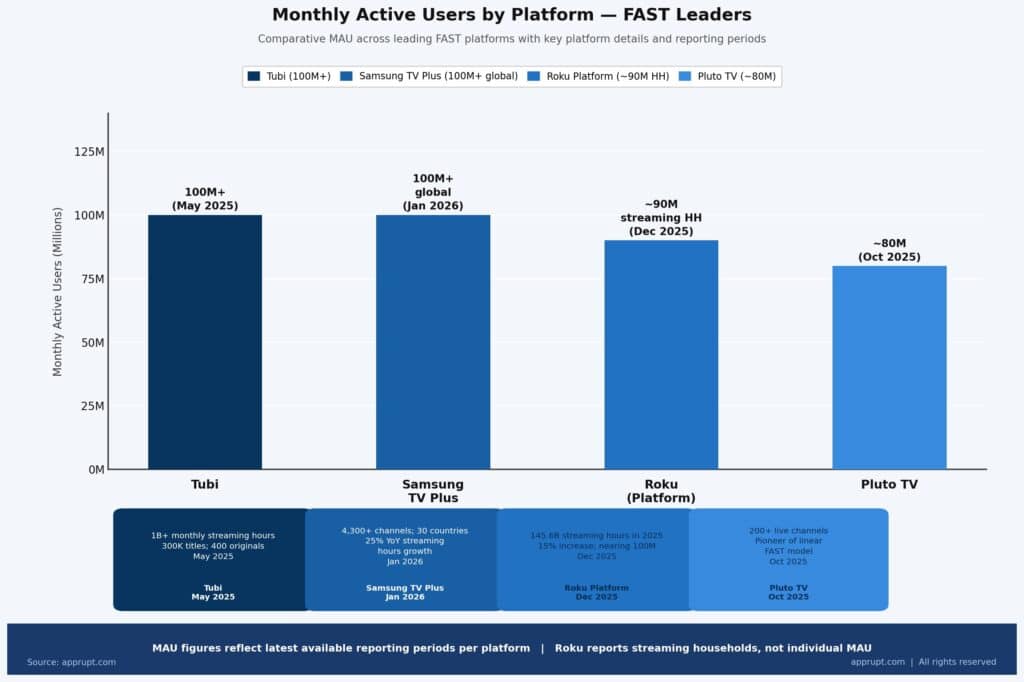
| Platform | MAU | Period | Key Details | Source |
| Tubi | 100M+ | May 2025 | 1B+ monthly streaming hours; 300K titles; 400 originals | |
| Samsung TV Plus | 100M+ global | Jan 2026 | 4,300+ channels; 30 countries; 25% YoY streaming hours growth | |
| Roku (platform) | ~90M streaming households | Dec 2025 | 145.6B streaming hours in 2025 (15% increase); nearing 100M | |
| Pluto TV | ~80M | Oct 2025 | 200+ live channels; pioneer of linear FAST model |
Samsung TV Plus grew from 88 million MAU in late 2024 to surpassing 100 million globally by January 2026, driven by a 25% year-over-year increase in streaming hours and a 50%+ increase in global viewership. It remains the most-used app on Samsung TV sets, with the service pre-installed on every Samsung smart TV sold since 2016.
Tubi became the first dedicated FAST service to break 100 million MAU in May 2025, with over 1 billion monthly streaming hours. Over 95% of Tubi’s viewing is on-demand (movies and TV shows), distinguishing it from the linear-focused model of Pluto TV or Samsung TV Plus. Tubi’s audience skews young—over 50% are Gen Z or Millennials—and 67% are cord-cutters or cord-nevers.
Roku’s CEO Anthony Wood stated in February 2026 earnings that Roku expects to “surpass 100 million streaming households this year,” noting that Roku now facilitates nearly half of all television streaming in the U.S..
The Roku Channel’s Breakout Year
The Roku Channel deserves special attention as the fastest-growing FAST platform in terms of TV share. Its share grew from 1.6% in September 2024 to a record 3.0% in December 2025—nearly doubling in just 15 months. Since 2020, FAST viewing on the Roku Channel has grown 262x relative to the overall TV streaming market, according to Nielsen. The channel surpassed both Tubi and Pluto TV to become the largest FAST service by Nielsen share in January 2025.
FAST as the #1 Live TV Source
One of the most significant viewership milestones in 2025 was FAST overtaking cable/satellite as the leading source for live TV viewing. According to Horowitz Research’s annual “State of Media, Entertainment & Tech: Viewing Behavior 2025” report:
- 40% of live TV viewers now watch live TV on FAST services
- Traditional cable/satellite follows at 36%
- Subscription streaming services are at 33%
- YouTube at 19%
- Virtual MVPDs at 16%
Among younger demographics, FAST’s dominance is even more pronounced: 53% of 18–34 year-olds and 47% of 35–49 year-olds use FAST for live TV, versus only 29% of 50+ year-olds. Live news and sports are the most popular live genres on FAST, followed by current episodes of new TV shows.
Viewer Demographics & Behavior
Age and Diversity
FAST audiences skew younger and more diverse than the general U.S. adult population:
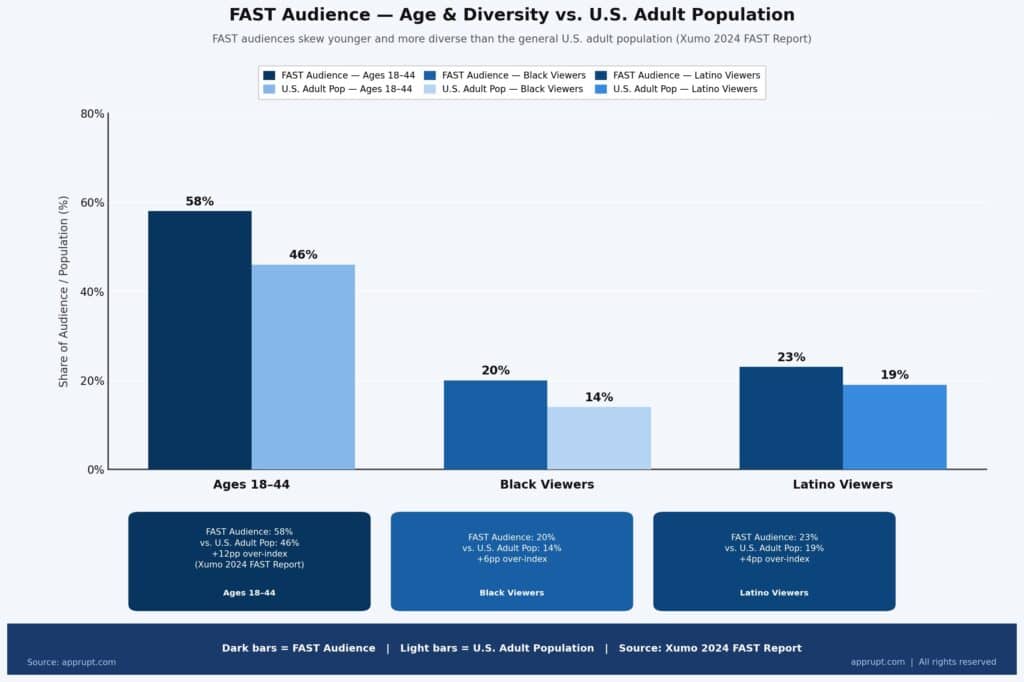
| Demographic | FAST Audience | U.S. Adult Population | Source |
| Ages 18–44 | 58% | 46% | Xumo 2024 FAST Report |
| Black viewers | 20% | 14% | |
| Latino viewers | 23% | 19% |
FAST news viewers are 7.4x more likely to be cord-cutters than the average viewer, and younger viewers are 2.1x more likely to watch news via FAST. This demographic profile makes FAST particularly attractive to advertisers seeking Gen Z and Millennial audiences that traditional TV struggles to reach.
Primetime Behavior
The average FAST viewer spends 1 hour and 40 minutes watching FAST channels per evening during primetime—comparable to gaming (1 hour 42 minutes), social media scrolling (1 hour 53 minutes), and cable TV viewing (1 hour 58 minutes). One-third of U.S. adults regularly watch FAST channels during peak primetime hours.
Content Preferences
According to the Roku/Horizon Futures Group study, content genre distribution for FAST viewing is:
- Entertainment: 52% of FAST hours
- News: 18%
- Unscripted programming: 17%
Wurl’s data shows reality programming leads individual genre share at 11%, followed by dramas (9.4%) and documentaries (7.6%). Notably, sports content—despite sports channels growing 105%+ in count—accounts for only about 2.6% of overall FAST viewing time, indicating enormous room for growth as more live sports rights migrate to FAST.
Linear vs. On-Demand
Linear FAST channels held 67.2% of total FAST viewing in 2025, reflecting the lean-back, cable-like viewing habits that many consumers bring to FAST. However, on-demand libraries are expanding at a 23% CAGR, as viewers increasingly seek control over their schedules. Half of all FAST streamers agree that FAST delivers content with personal favorites they enjoy watching repeatedly—their top marker of “premium” content.
Content-Driven Viewership Growth
Sports
Live sports are rapidly emerging as a FAST viewership catalyst:
- Sports streaming hours on FAST grew 65% YoY, with sports channel viewership surging 150% globally
- Sports programming on major streaming platforms surged 52% year-over-year as of February 2026
- Sports FAST channels now number 220+, more than doubling YoY
- Tubi’s simulcast of Super Bowl LIX in February 2025 was a watershed moment—the first-ever FAST Super Bowl broadcast
Local News
Local news on FAST is experiencing explosive growth. In August 2025, an average of 61,000 viewers tuned into local stations via OTT, a 69% year-over-year increase. Currently, 25% of U.S. households have consumed news content on a FAST channel, and FAST exclusively reaches a quarter of all news-watching households—audiences that cable/network news cannot reach.
International Content
Korean dramas, Japanese anime, and Southeast Asian series have seen major viewership growth on FAST platforms. Between 2020 and 2024, Korean TV series alone are estimated to have generated $8 billion in global streaming revenue. This international content is driving FAST viewership in North America, Europe, Latin America, and the Middle East.
International Viewership
Europe
Spain leads European FAST adoption at 35% of online adults watching monthly, followed by the UK (26%), Germany (25%), and France (17%). Europe saw strong activity in early 2026, particularly from public broadcasters and telecom groups expanding their direct-to-consumer FAST presence. The UK is approaching a tipping point where streaming will overtake traditional TV viewing.
Latin America
FAST viewership in Latin America is up sharply since 2020, driven by consumers favoring low-cost or bundled, ad-supported options. Mobile viewing dominates in the region, with local content—including regional entertainment and live sports—serving as a key viewership driver. FAST households in Latin America are projected to reach 52 million by 2029.
Asia-Pacific
Asia-Pacific is the fastest-growing FAST region for both viewership and revenue. India’s CTV user base has grown approximately 87% in recent years, reaching 50 million CTV households by mid-2025 with a target of 60 million by year-end. About 91% of the Indian population engages with advertisements while consuming content, signaling strong FAST potential. In Africa and Southeast Asia, mobile-first consumption patterns are driving FAST adoption, with demand for bite-sized, regional content.
Cord-Cutting as Viewership Tailwind
The accelerating decline of traditional pay-TV directly fuels FAST viewership growth. Key cord-cutting metrics as of late 2025:
- Streaming hit a record 47.5% of U.S. TV viewing in December 2025
- Cable dropped to 20.2% of total TV
- Over 80 million U.S. households have cut the cord
- Comcast lost 1.15 million TV subscribers in 2025 alone
- 50% of Americans under 32 won’t pay for cable TV
- Analysts project streaming will sustain over 50% of all TV viewing by late 2026
Each price increase from cable providers pushes more subscribers toward free streaming alternatives. Streaming exceeded combined broadcast + cable viewing for the first time in May 2025, a historic milestone that underscores the structural shift powering FAST viewership.
Outlook: 2027 and Beyond
FAST viewership is expected to continue growing through at least 2030, driven by several structural factors:
- Smart TV penetration: FAST apps come pre-installed on virtually all new smart TVs, providing zero-friction discovery. Samsung TV Plus alone is accessible on over 500 million devices globally.
- Content quality improvement: Platforms are investing heavily in originals (Tubi has 400+ originals), live sports, and award-winning content. More than 1,000 Oscar-, Emmy-, and SAG-nominated titles were streamed free on the Roku Channel in the past year.
- Subscription fatigue intensification: As SVOD prices continue to rise, free alternatives become more attractive. Netflix alone now sees 45% of U.S. viewing on its ad tier, demonstrating broad consumer acceptance of ad-supported models.
- AI-driven personalization: Advanced content discovery and targeted ad insertion are improving the FAST user experience, with AI-driven personalization and measurement expected to become standard by 2027.
- International expansion: Non-U.S. markets are growing at faster rates than the U.S., with Latin America, Europe, and Asia-Pacific providing large untapped viewer pools.
- Advertising sophistication: As ad targeting, measurement, and interactive formats improve, higher CPMs will attract better content, creating a virtuous cycle of improved programming attracting more viewers.
Despite some early signs of user-acquisition plateaus in mature markets, the overall trajectory is clear: FAST is transitioning from a disruptive niche into a permanent, core component of the global television ecosystem. Industry analysts project that the global FAST market will exceed $40 billion in revenue by 2033, sustained by a viewer base that will continue expanding both in the U.S. and internationally.
