Amazon Prime is estimated to have between 220 million and 250 million paying members globally as of early 2026, making it the world’s largest paid retail membership program. In the United States alone, the Consumer Intelligence Research Partners (CIRP) estimates 201 million Amazon customers held a Prime membership as of December 2025, a 4% year-over-year increase. Amazon last officially disclosed its global member count in April 2021, when it surpassed 200 million, and has since declined to release exact figures in earnings reports or investor calls.
Amazon’s subscription services segment — which primarily reflects Prime fees alongside digital content subscriptions — generated $49.62 billion in revenue in FY2025, up 12% from $44.37 billion in 2024. Meanwhile, Prime Video’s ad-supported tier has grown to over 315 million monthly active viewers globally, making it the largest ad-supported streaming audience in the world. Amazon is now the top streaming spender on sports rights, investing $3.8 billion in live sports in 2026 alone.
Global Prime Membership
Current Estimates
Because Amazon stopped publicly disclosing subscriber numbers after early 2021, all current figures rely on third-party research estimates. These vary significantly depending on methodology:
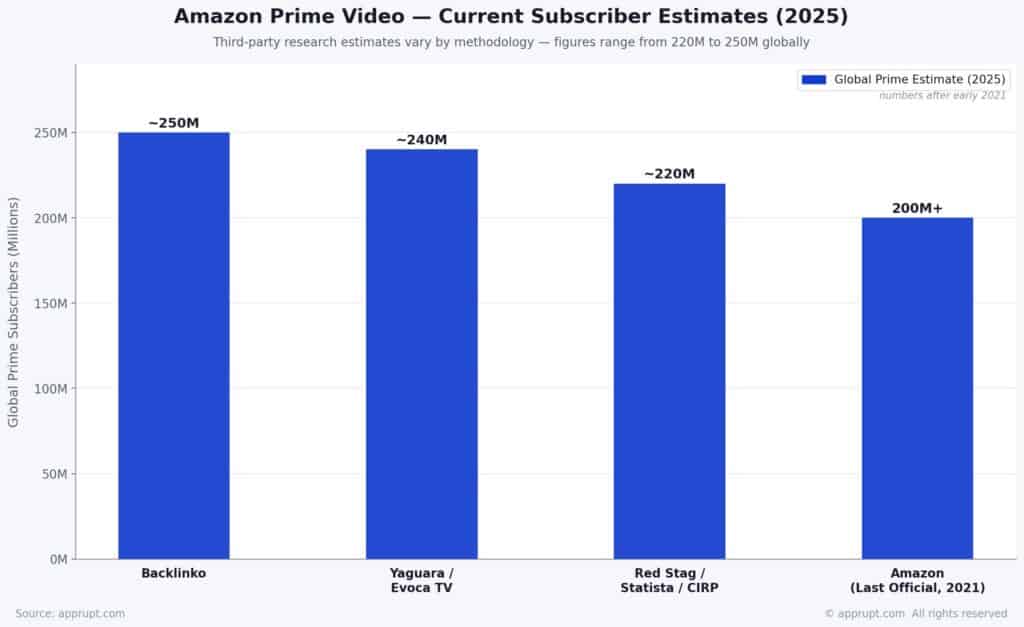
| Source | Global Prime Estimate (2025) |
| Backlinko | ~250 million |
| Yaguara / Evoca TV | ~240 million |
| Red Stag / Statista / CIRP | ~220 million |
| Amazon (last official, 2021) | 200 million+ |
The discrepancy stems from differing definitions — some sources count individual users (including family members sharing a single subscription), while others count paid households. CIRP’s US-specific methodology counts individual shoppers with Prime access, yielding a higher number than household-based estimates.
Growth Trajectory
Amazon Prime’s membership has grown roughly fivefold in a decade, from approximately 50 million in 2015 to an estimated 220–250 million in 2025:
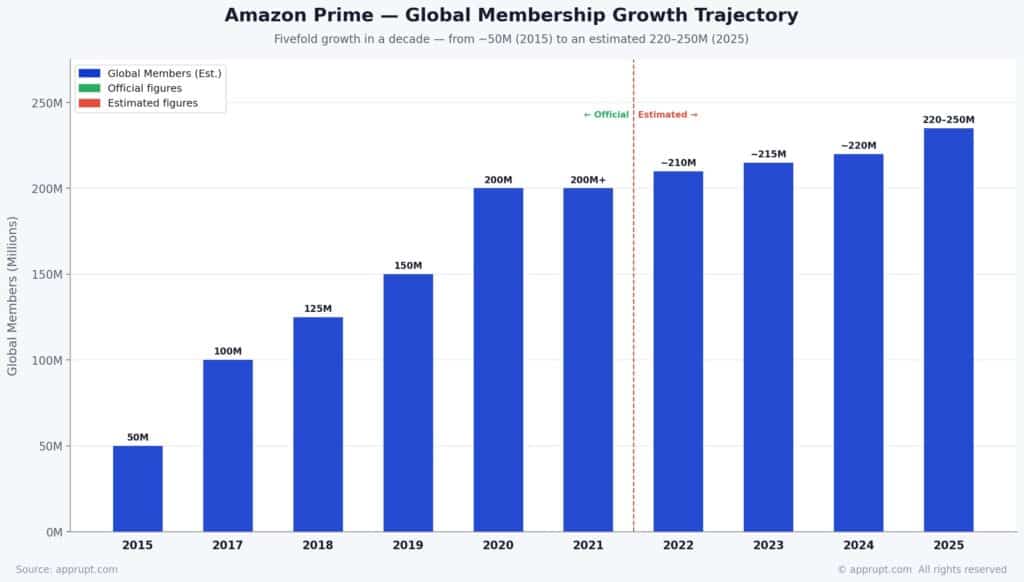
| Year | Global Members (Est.) | Notes |
| 2015 | 50M | Early international expansion |
| 2017 | 100M | First official 100M announcement |
| 2018 | 125M | Rapid growth phase |
| 2019 | 150M | Pre-pandemic |
| 2020 | 200M | COVID-driven surge (official) |
| 2021 | 200M+ | Last official figure |
| 2022 | ~210M | Estimated |
| 2023 | ~215M | Estimated |
| 2024 | ~220M | Estimated |
| 2025 | 220–250M | Range across sources |
| Growth has notably decelerated since the pandemic-era surge. The US market in particular is approaching saturation, with over 80% of American households estimated to have a Prime membership. Future growth is increasingly driven by international markets, especially India and emerging economies. |
US Prime Membership
The United States remains the core of Amazon Prime’s member base, accounting for approximately 75–80% of all global subscribers. CIRP’s December 2025 survey estimated 201 million US Amazon customers with Prime membership, crossing the 200 million threshold for the first time. This represented a 4% increase from 194 million in December 2024 and a slight uptick from the 200 million estimate in the prior quarter.
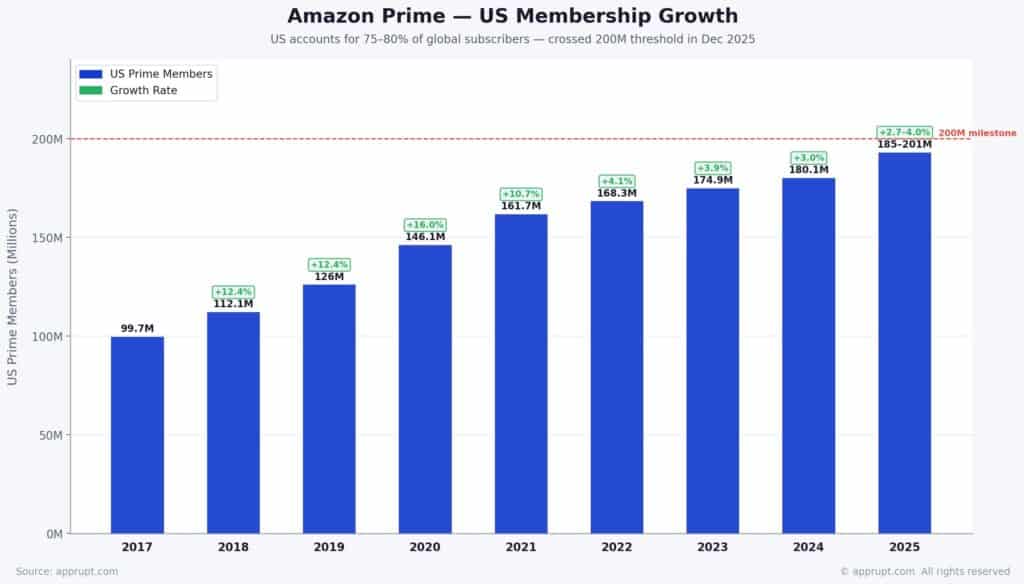
| Year | US Prime Members | Growth Rate |
| 2017 | 99.7M | — |
| 2018 | 112.1M | 12.4% |
| 2019 | 126M | 12.4% |
| 2020 | 146.1M | 16.0% |
| 2021 | 161.7M | 10.7% |
| 2022 | 168.3M | 4.1% |
| 2023 | 174.9M | 3.9% |
| 2024 | 180.1M | 3.0% |
| 2025 | 185–201M | 2.7–4.0% |
Growth has steadily slowed from double-digit annual rates before 2021 to low single digits, reflecting market maturity. Among an estimated 310 million Amazon customers in the US, over 65% are Prime members. About 42% of members maintain annual subscriptions while 58% pay monthly. The age distribution skews older: 29% of members are over 65, 21% are aged 55–64, and 19% are 45–54.
Prime Video Statistics
Ad-Supported Tier Dominance
Amazon introduced advertising on Prime Video in January 2024, automatically enrolling all existing viewers into the ad-supported tier. As of November 2025, Prime Video’s ad tier reached over 315 million monthly active viewers globally, up from 200 million in April 2024 — a 58% increase in roughly 18 months.
Approximately 82% of Prime Video users remain on the ad-supported tier, with only about 20% opting to pay an additional $2.99/month for the ad-free experience. This gives Prime Video the highest ad-tier adoption rate among major streaming platforms:
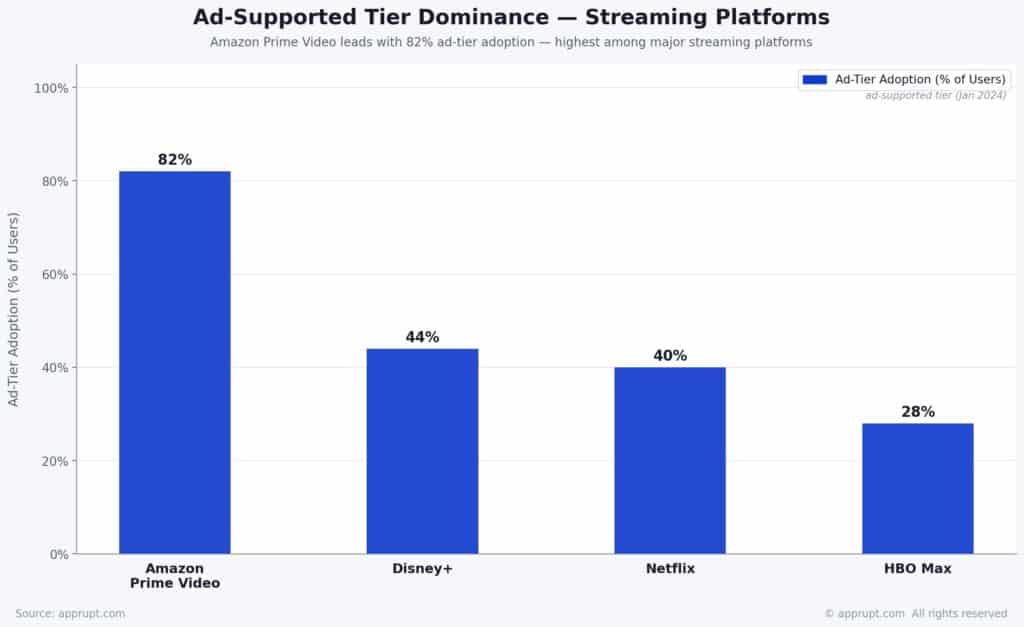
| Platform | Ad-Tier Adoption (% of Users) |
| Amazon Prime Video | 82% |
| Disney+ | 44% |
| Netflix | 40% |
| HBO Max | 28% |
US Streaming Market Share
Prime Video claimed 22% of the US streaming market share during 2024, narrowly edging out Netflix at 21%, according to JustWatch data. However, as of early 2026, Netflix has reclaimed the top spot with 20% market share versus Prime Video’s 19%. The two platforms continue to trade the top position depending on content cycles and measurement methodology.
Viewers by Country
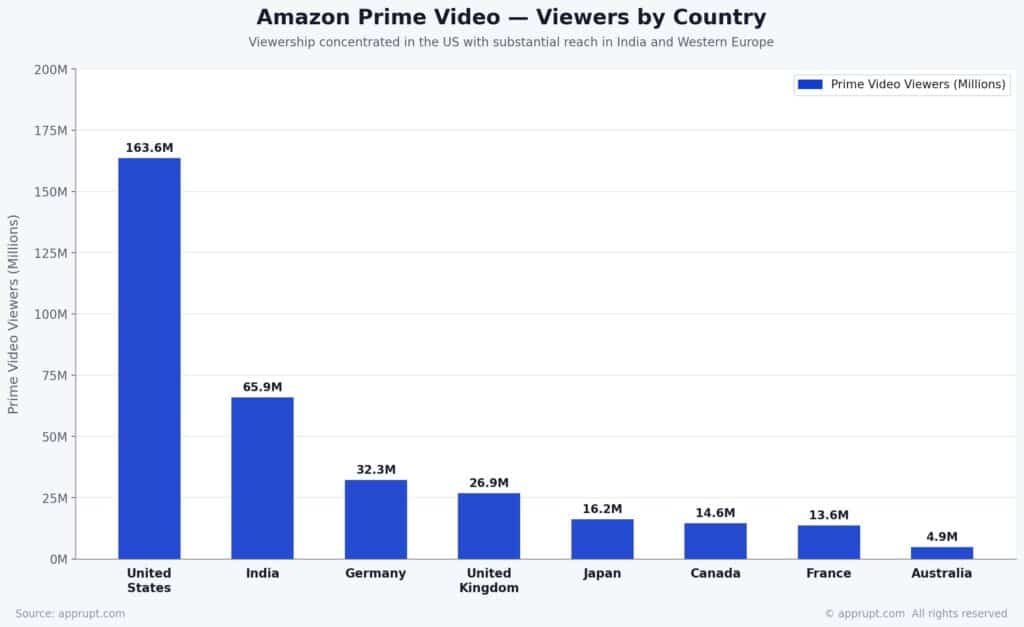
Prime Video’s viewership is concentrated in the United States but has substantial reach in India and Western Europe:
| Country | Prime Video Viewers |
| United States | 163.6M |
| India | 65.9M |
| Germany | 32.3M |
| United Kingdom | 26.9M |
| Japan | 16.2M |
| Canada | 14.6M |
| France | 13.6M |
| Australia | 4.9M |
Prime Video Subscriber Projections
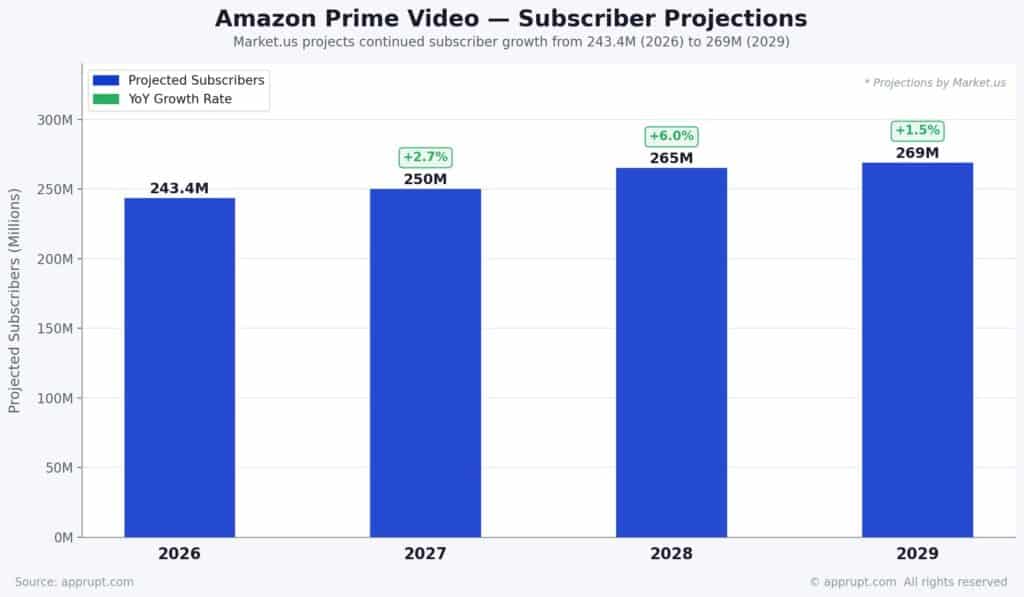
Market.us projects Prime Video subscriber growth to continue as follows:
| Year | Projected Subscribers |
| 2026 | 243.4M |
| 2027 | 250M |
| 2028 | 265M |
| 2029 | 269M |
Revenue and Financial Performance
Subscription Services Revenue
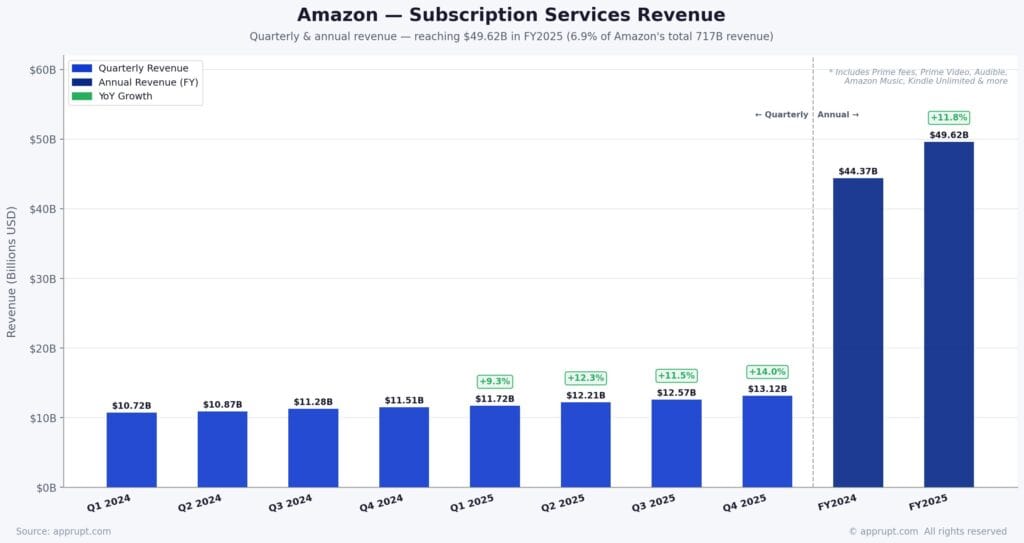
Amazon’s subscription services segment — encompassing Prime membership fees, Prime Video, Audible, Amazon Music, Kindle Unlimited, and other subscriptions — has grown steadily, reaching $49.62 billion in FY2025:
| Quarter | Revenue | YoY Growth |
| Q1 2024 | $10.72B | — |
| Q2 2024 | $10.87B | — |
| Q3 2024 | $11.28B | — |
| Q4 2024 | $11.51B | — |
| Q1 2025 | $11.72B | 9.3% |
| Q2 2025 | $12.21B | 12.3% |
| Q3 2025 | $12.57B | 11.5% |
| Q4 2025 | $13.12B | 14.0% |
| FY2024 | $44.37B | — |
| FY2025 | $49.62B | 11.8% |
| Subscription revenue represented approximately 6.9% of Amazon’s total $717 billion in FY2025 revenue. Q3 2025 set a record for Prime subscription revenue at $12.57 billion. |
Advertising Revenue
Amazon’s broader advertising services segment generated $17.7 billion in Q3 2025 alone, a 24% year-over-year increase. Within this, Prime Video-specific advertising revenue was estimated at $433 million in 2024 and is forecast to grow to $806 million in 2025. S&P Global Kagan estimates that the ad-supported version of Prime Video reaches over 130 million US consumers monthly. Broader CTV advertising revenue projections from eMarketer suggest Amazon could pull in over $3.88 billion in connected TV ad revenue by 2025.
Content Spending
Total Investment
Amazon spent $22.4 billion on content (video and music combined) in 2025, a 10% increase from the prior year. This makes Amazon the largest content spender among streaming platforms, surpassing Netflix’s $18 billion in 2025. However, a significant portion of Amazon’s figure includes music licensing costs, which are not typically included in Netflix’s content budget.
Amazon’s annual content budget specifically for original and licensed movies, TV shows, and live sports was approximately $7 billion in 2024. CEO Andy Jassy has steered the company toward prioritizing live sports over scripted entertainment as a more reliable audience driver and path to profitability for the video unit.
Sports Rights
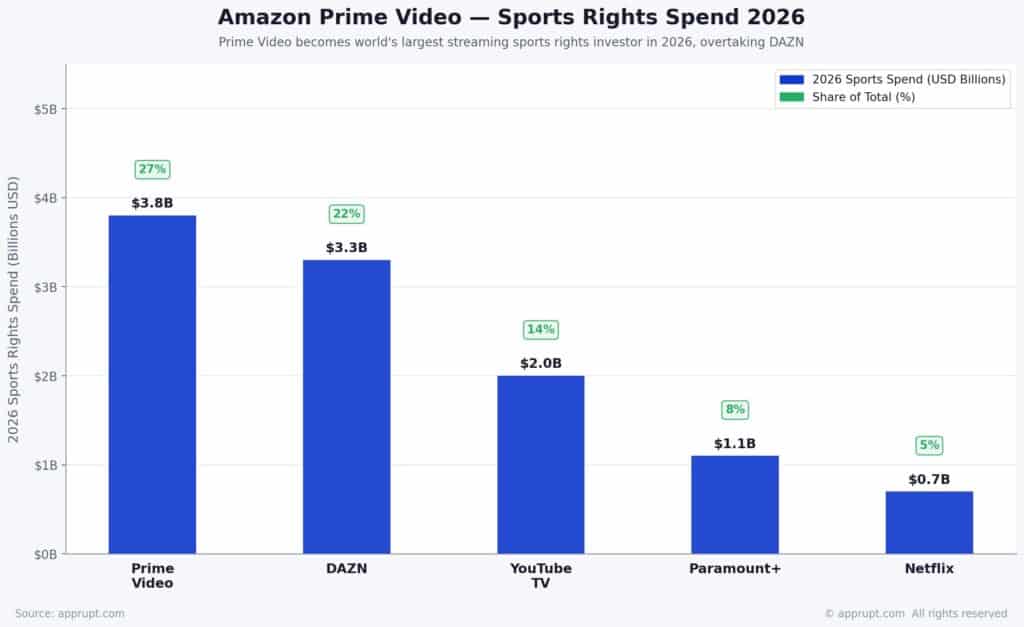
Amazon Prime Video will become the world’s largest streaming investor in sports rights in 2026, overtaking DAZN for the first time:
| Platform | 2026 Sports Spend | Share of Total |
| Prime Video | $3.8B | 27% |
| DAZN | $3.3B | 22% |
| YouTube TV | $2.0B | 14% |
| Paramount+ | $1.1B | 8% |
| Netflix | $0.7B | 5% |
| Key sports deals include: |
- NFL Thursday Night Football: ~$1 billion/year, with the fourth season averaging 15 million+ viewers (16% YoY increase) and the most-streamed NFL game in history (31 million+ viewers for the Packers vs. Bears Wild Card game)
- NBA: 11-year deal worth $1.8 billion/year, with 2026 as the first full season
- UEFA Champions League: Extended through 2031 in Germany, Ireland, Italy, and the UK, with record-breaking 10 million viewers in a single evening
Pricing Structure
US Pricing (2026)
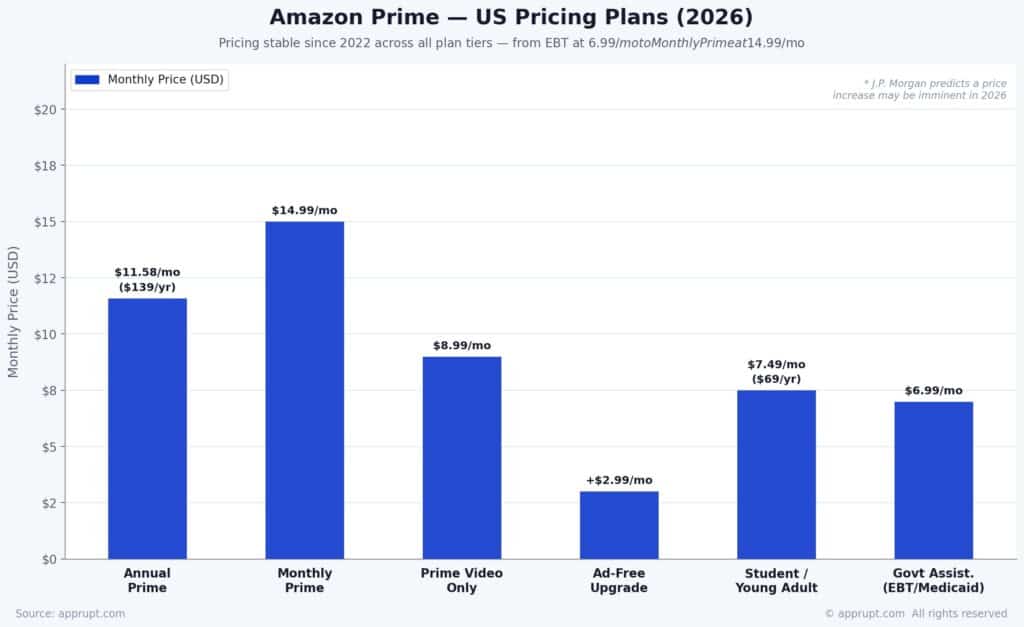
Amazon Prime pricing has remained stable since 2022, though J.P. Morgan analysts predict a price increase may be imminent in 2026:
| Plan | Price |
| Annual Prime | $139/year ($11.58/month) |
| Monthly Prime | $14.99/month |
| Prime Video Only | $8.99/month |
| Ad-Free Upgrade | +$2.99/month |
| Student / Young Adult | $7.49/month or $69/year |
| Government Assistance (EBT/Medicaid) | $6.99/month |
India Pricing
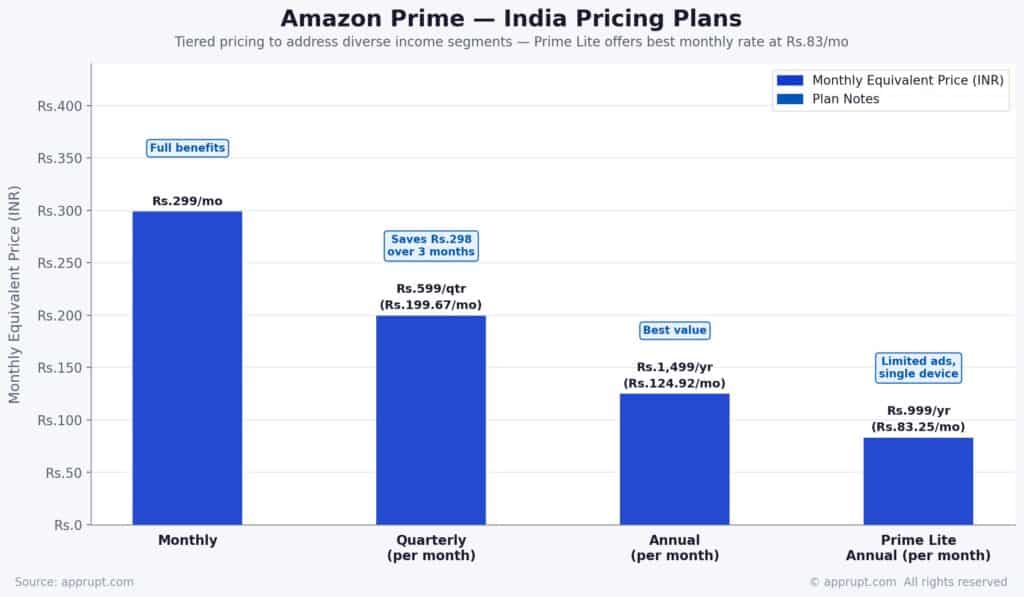
India offers tiered pricing to address diverse income segments:
| Plan | Price | Notes |
| Monthly | ₹299/month | Full benefits |
| Quarterly | ₹599/quarter | Saves ₹298 over 3 months |
| Annual | ₹1,499/year | Best value |
| Prime Lite (Annual) | ₹999/year | Limited ads, single device video |
Amazon Prime in India
India is Amazon Prime’s fastest-growing market and a critical driver of future expansion. In 2025, Amazon Prime India achieved its quickest growth rate to date, with nearly 70% of new Prime memberships coming from Tier-2 and Tier-3 cities. Key India milestones include:
- Amazon delivered over 550 million (55 crore) products via same-day or next-day delivery in 2025, a 40% year-over-year increase
- Amazon invested ₹2,000 crore ($240 million) in delivery infrastructure improvements in India during 2025
- Four out of five Prime members in India regularly use Prime Video, and one in three engages with Amazon Music
- Prime Video holds approximately 25% of India’s OTT market share as of early 2026, making it the market leader
- Nearly 66 million viewers in India use Prime Video
- On average, Prime members saved more than twice their annual membership cost through shopping benefits alone; the top 10% saved eight times the membership fee
Amazon’s dual-platform strategy in India — combining the premium Prime Video subscription with free, ad-supported content via Amazon MX Player — allows it to cover both premium and mass-market consumer segments. Content is available in 10 regional Indian languages.
Competitive Landscape
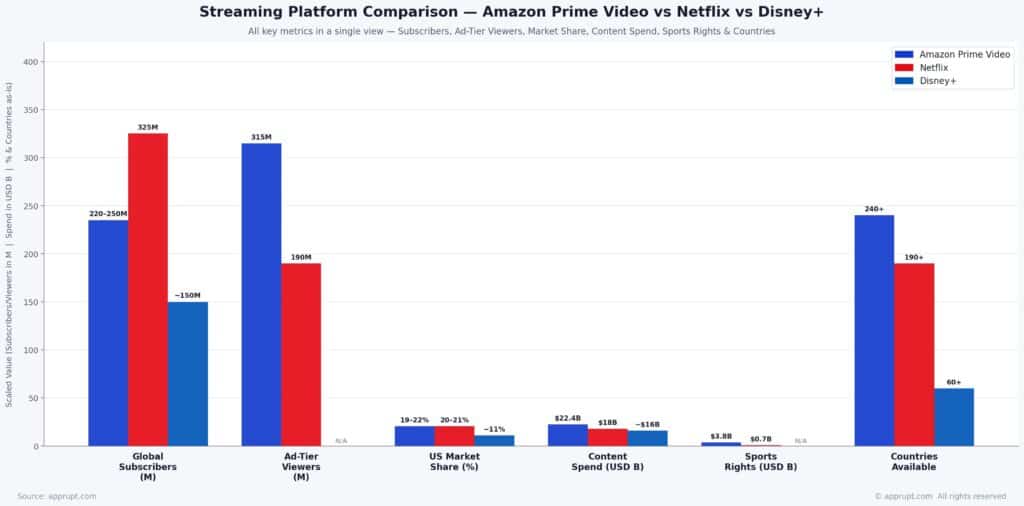
Streaming Platform Comparison
| Metric | Amazon Prime Video | Netflix | Disney+ |
| Global Subscribers | 220–250M (Prime) | 325M | ~150M |
| Ad-Tier Monthly Viewers | 315M | 190M | — |
| US Market Share | 19–22% | 20–21% | ~11% |
| Content Spend (2025) | $22.4B (incl. music) | $18B | ~$16B |
| Sports Rights (2026) | $3.8B | $0.7B | — |
| US Pricing (Entry) | $8.99/mo (Video only) | $7.99/mo (w/ ads) | $9.99/mo |
| 4K Included | All plans | Premium only ($24.99) | Premium only |
| Countries Available | 240+ | 190+ | 60+ |
Amazon’s key differentiator remains the bundle advantage — Prime Video comes as part of the broader Prime ecosystem that includes free shipping, Prime Music, Prime Gaming, Prime Reading, and Grubhub+, creating a value proposition unmatched by any pure-play streaming service.
Viewing Time Challenge
Despite its massive subscriber base, Prime Video users watch significantly less content on the platform compared to competitors — approximately 41 minutes less per day than Netflix users. This “engagement gap” is a key concern for Amazon, which is betting that increased investment in live sports and franchise content will narrow the difference.
Growth Projections and Outlook
Short-Term (2026–2027)
- Subscription revenue growth is expected to maintain 11–14% annual growth, supported by higher international adoption and potential US price increases
- Prime Video subscriber base is projected to reach approximately 243 million by end of 2026 and 250 million by 2027
- Ad revenue acceleration will continue as Amazon’s ad tech infrastructure matures across its 315 million monthly viewer base
- A US price hike in 2026 is widely anticipated by analysts, following four years of stable pricing at $139/year
Medium-Term (2028–2030)
- Prime Video subscribers projected to reach 265 million by 2028 and 269 million by 2029
- Amazon’s advertising segment is expected to mature into a $75–85 billion business by 2028, with Prime Video and Twitch contributing a growing share
- AWS revenue projected to reach $140–160 billion by 2028, with AI infrastructure services creating synergies for ad targeting and content recommendations
- The overall global SVOD market is expected to surpass 2 billion total subscriptions by 2029, with Amazon maintaining its position as the second-largest platform
Key Growth Drivers
- Live sports: The NFL, NBA, and UEFA Champions League portfolio gives Amazon year-round premium live content across the world’s two most popular domestic leagues
- India and emerging markets: With 70% of new Indian sign-ups from non-metro cities and pricing tiers starting at ₹399, Amazon is aggressively expanding beyond urban centers
- Ad-tier monetization: The 82% ad-tier adoption rate creates an enormous and growing ad revenue opportunity, with CTV advertising projected to be a multi-billion dollar business
- Bundle ecosystem: The flywheel between e-commerce, entertainment, and AI-powered services (Alexa+) creates switching costs that pure streaming competitors cannot replicate
- Channel aggregation: Prime Video Channels allows third-party services (Peacock, Paramount+, Apple TV+, Crunchyroll) to be added as subscriptions, positioning Amazon as a super-aggregator
Challenges and Risks
- Opaque reporting: Amazon’s refusal to disclose official subscriber counts since 2021 makes accurate benchmarking difficult and reduces investor transparency
- Content quality perception: Despite outspending Netflix, Prime Video is still perceived as weaker in original content depth and cultural impact, with hits like The Boys and Reacher being exceptions rather than the rule
- Viewing engagement: The 41-minute daily viewing gap versus Netflix suggests subscribers view Prime Video as a secondary platform rather than a primary entertainment destination
- US market saturation: With over 80% household penetration, meaningful subscriber growth in the US is increasingly difficult
- Price sensitivity: An anticipated price increase in 2026 could trigger churn, particularly among cost-conscious monthly subscribers who make up 58% of the base
- Rising sports costs: The $1.8 billion/year NBA deal and escalating rights fees create long-term cost pressure that must be offset by ad revenue and subscriber retention
Conclusion
Amazon Prime’s position as the world’s largest paid membership program is secure, with an estimated 220–250 million members globally and 201 million in the US alone. The introduction of advertising on Prime Video has created a massive 315 million monthly viewer base that is rapidly becoming one of the most valuable advertising platforms in connected television. Amazon’s $3.8 billion investment in sports rights in 2026 — overtaking DAZN as the top streaming sports spender — underscores a strategic pivot toward live content as the primary driver of engagement and ad revenue. India represents the most promising growth frontier, with 70% of new sign-ups coming from smaller cities and Prime Video commanding a 25% market share. Looking ahead, the combination of Prime’s unmatched bundle ecosystem, aggressive international expansion, and rapidly scaling ad revenue positions Amazon to continue challenging Netflix for streaming supremacy through the end of the decade.
