Paramount+ ended 2025 with 79 million paid global subscribers, a figure that remained essentially flat year-over-year after accounting for international bundle expirations and a methodology change excluding free-trial users. Despite subscriber stagnation, the platform’s financial health improved markedly: DTC revenue grew 10% in Q4 2025, Paramount+ revenue surged 17%, and ARPU climbed 10% year-over-year. The Skydance-Paramount merger, completed in August 2025, injected new strategic direction under CEO David Ellison, including $1.5 billion in incremental content spending for 2026 and a landmark 7-year, $7.7 billion UFC rights deal.
The most transformative event ahead is Paramount Skydance’s $110 billion acquisition of Warner Bros. Discovery, announced in February 2026, which will combine Paramount+ and HBO Max into a single streaming platform with approximately 200 million subscribers globally. This positions the merged entity as the second-largest streaming service worldwide, behind only Netflix.
Historical Subscriber Growth
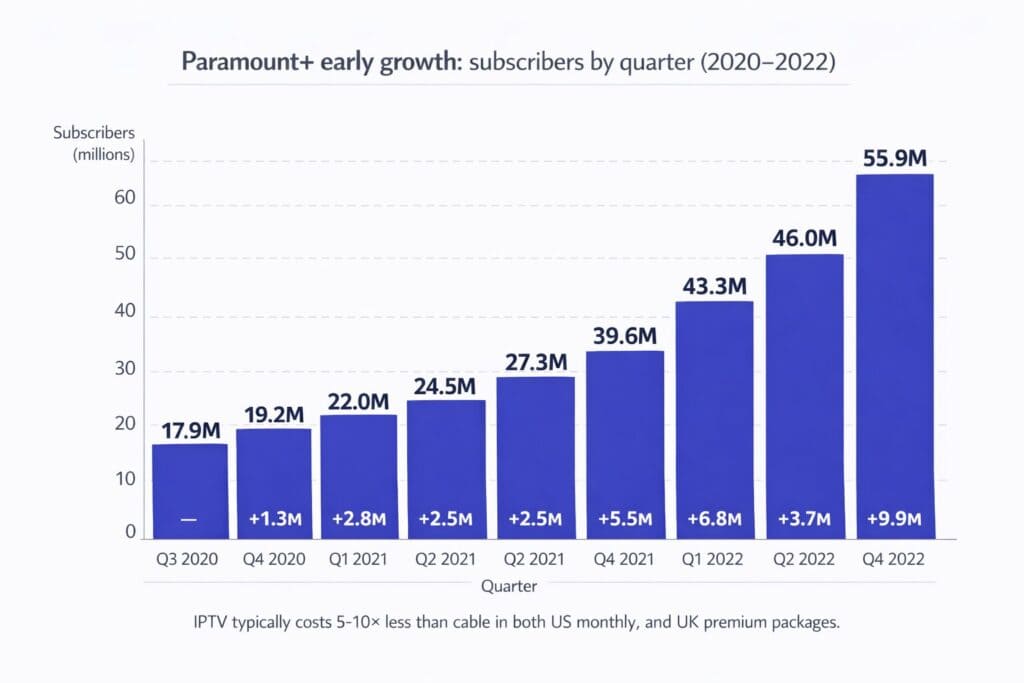
Early Growth Phase (2020–2022)
Paramount+ launched on March 4, 2021, replacing CBS All Access and rapidly expanding its global footprint through distribution deals in Latin America, Europe, Australia, and Asia. The platform experienced explosive growth in its first two years, fueled by franchise content like 1883, Halo, and NFL football.
| Quarter | Subscribers (millions) | Quarterly Change |
| Q3 2020 | 17.9 | — |
| Q4 2020 | 19.2 | +1.3 |
| Q1 2021 | 22.0 | +2.8 |
| Q2 2021 | 24.5 | +2.5 |
| Q3 2021 | 27.3 | +2.8 |
| Q4 2021 | 32.8 | +5.5 |
| Q1 2022 | 39.6 | +6.8 |
| Q2 2022 | 43.3 | +3.7 |
| Q3 2022 | 46.0 | +2.7 |
| Q4 2022 | 55.9 | +9.9 |
Source
Q4 2022 marked the platform’s largest quarterly gain at 9.9 million additions, fueled by NFL content and international launches. Between Q3 2020 and Q4 2022, Paramount+ grew more than seven-fold from 17.9 million to 55.9 million subscribers.
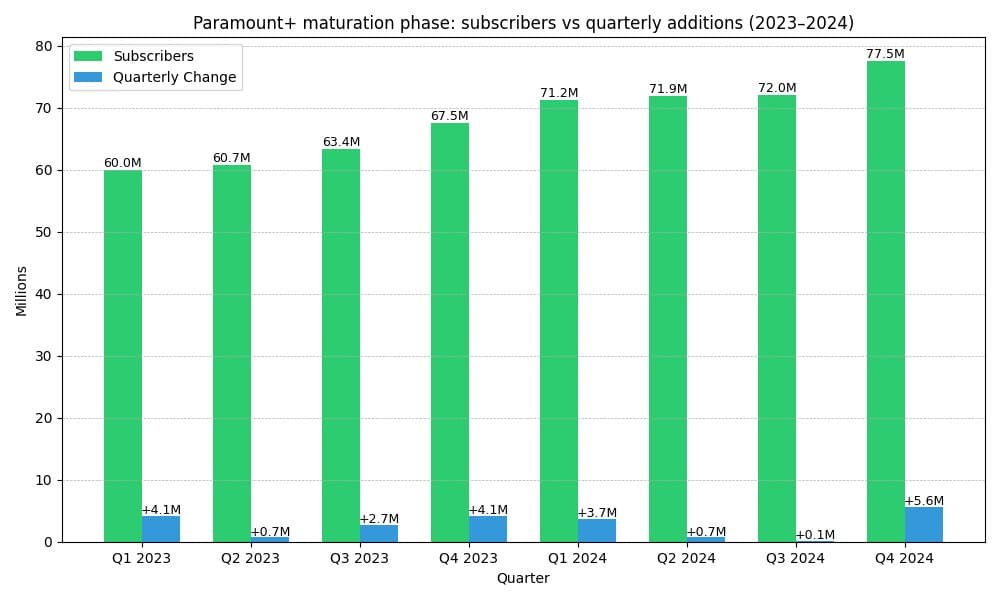
Maturation Phase (2023–2024)
Growth moderated in 2023 as the streaming industry broadly shifted focus from subscriber acquisition to profitability. The platform continued adding subscribers at a steadier pace, ending the year with 67.5 million.
| Quarter | Subscribers (millions) | Quarterly Change |
| Q1 2023 | 60.0 | +4.1 |
| Q2 2023 | 60.7 | +0.7 |
| Q3 2023 | 63.4 | +2.7 |
| Q4 2023 | 67.5 | +4.1 |
| Q1 2024 | 71.2 | +3.7 |
| Q2 2024 | 71.9 | +0.7 |
| Q3 2024 | 72.0 | +0.1 |
| Q4 2024 | 77.5 | +5.6 |
Source
The year 2024 ended strongly, with Q4’s 5.6 million additions representing the best quarterly performance in two years. Full-year 2024 added approximately 10 million subscribers, bringing the total to 77.5 million. The DTC segment’s annual losses improved by $1.2 billion, narrowing from $1.66 billion in 2023 to $497 million in 2024.
2025 Performance
Quarterly Subscriber Trends
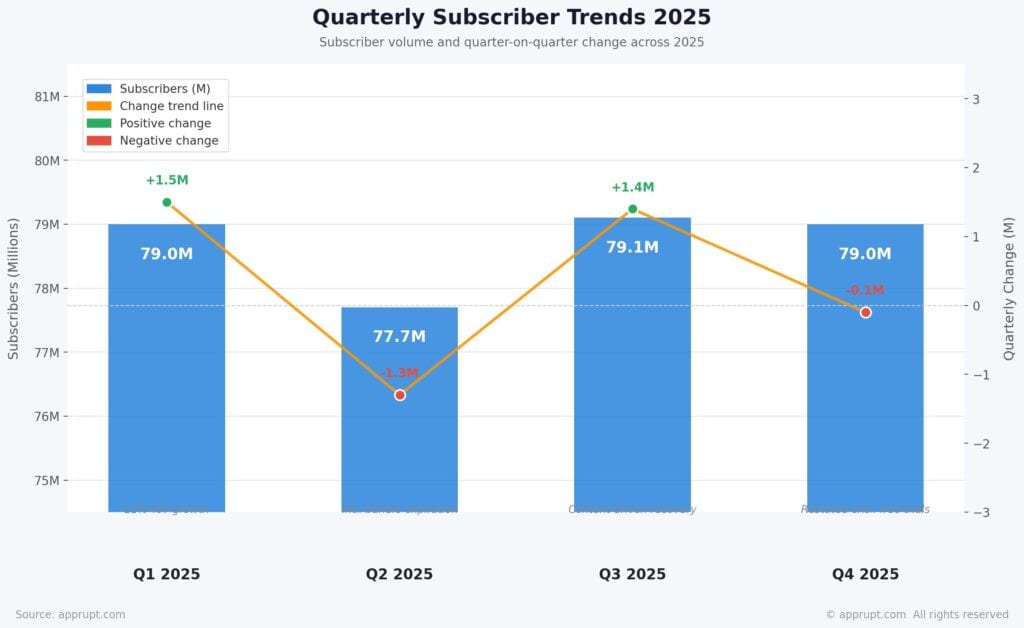
The 2025 subscriber trajectory was shaped by three factors: healthy underlying growth, the expiration of unfavorable international bundle partnerships, and a methodological change in Q4 that excluded free-trial users from reported totals.
| Quarter | Subscribers (millions) | Quarterly Change | Key Driver |
| Q1 2025 | 79.0 | +1.5 | 11% YoY growth |
| Q2 2025 | 77.7 | -1.3 | International bundle expiration |
| Q3 2025 | 79.1 | +1.4 | Content-driven recovery |
| Q4 2025 | 79.0 | -0.1 | Restated excluding free trials |
Despite the Q2 dip — attributed to the termination of an international distribution bundle — Paramount+ revenue still surged 23% year-over-year that quarter, demonstrating that higher ARPU from retained subscribers more than compensated for the subscriber loss. Viewership engagement also improved, with watch time per subscriber up 11% and total viewing hours across Paramount+ and Pluto TV up 31% year-over-year in Q1 2025.
Financial Performance
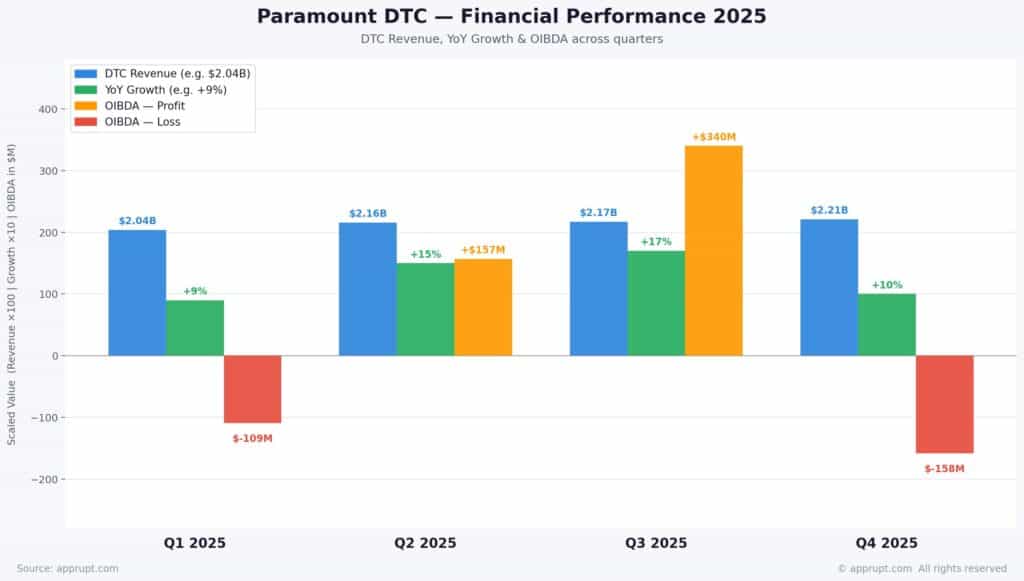
Paramount’s DTC business achieved a significant milestone in 2025: full-year profitability for its streaming operations, a target the company had been pursuing since its streaming-first pivot.
| Metric | Q1 2025 | Q2 2025 | Q3 2025 | Q4 2025 |
| DTC Revenue | $2.04B | $2.16B | $2.17B | $2.21B |
| DTC YoY Growth | +9% | +15% | +17% | +10% |
| DTC OIBDA | -$109M | +$157M | +$340M | -$158M |
Full-year DTC revenue reached approximately $8.6 billion, with Paramount+ accounting for more than 80% of this total. The Q4 loss was attributed to “seasonally higher content costs,” while full-year DTC profitability improved substantially relative to the $497 million loss in 2024.
Total company revenue for 2025 was $29.03 billion, though the company posted a net loss of $3.13 billion primarily due to restructuring charges and programming write-downs associated with the Skydance merger.
ARPU Trends
Average revenue per user has become a central metric as Paramount shifts from subscriber growth to revenue optimization.
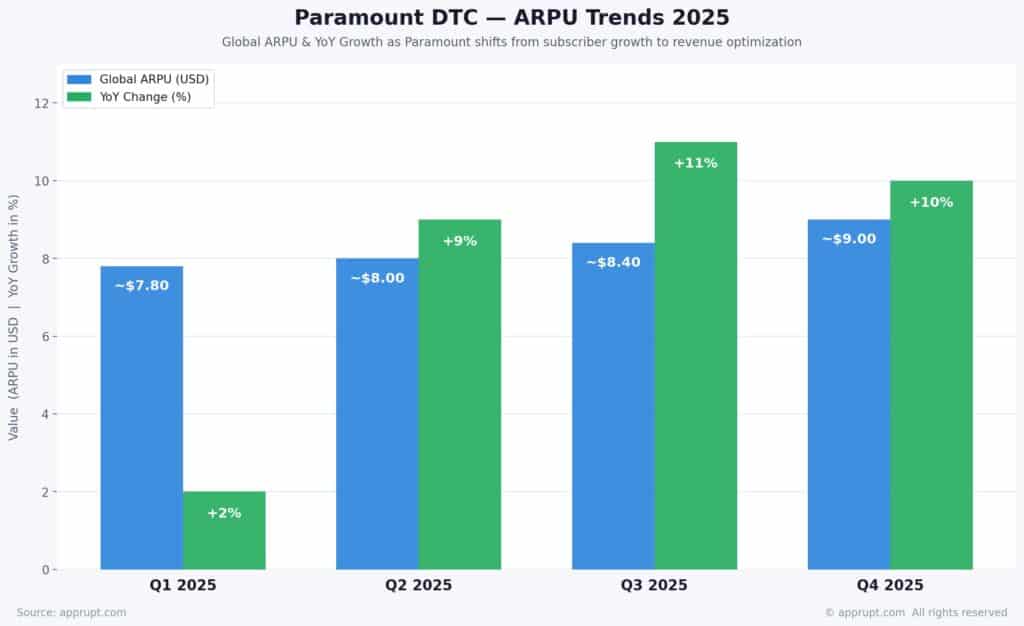
| Period | Global ARPU | YoY Change |
| Q1 2025 | ~$7.80 (est.) | +2% |
| Q2 2025 | ~$8.00 (est.) | +9% |
| Q3 2025 | $8.40 | +11% |
| Q4 2025 | ~$9.00+ (est.) | +10% |
ARPU acceleration was driven by the January 2024 and January 2026 price increases, higher ad-tier monetization, and the intentional exit of low-value international bundle subscribers.
Pricing Tiers (2026)
Paramount+ implemented its latest price increase on January 15, 2026, alongside the elimination of free trials for new subscribers.
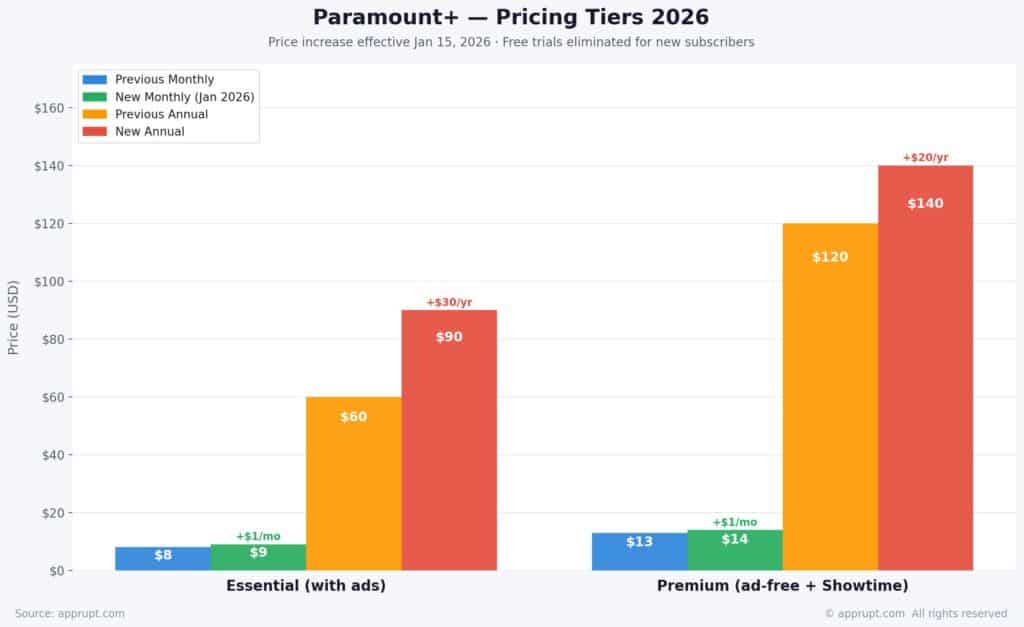
| Plan | Previous Monthly | New Monthly (Jan 2026) | Previous Annual | New Annual |
| Essential (with ads) | $8.00 | $9.00 | $60.00 | $90.00 |
| Premium (ad-free + Showtime) | $13.00 | $14.00 | $120.00 | $140.00 |
Source
The annual pricing increase was notably steeper in percentage terms — Essential rose 50% ($60 to $90) and Premium rose 17% ($120 to $140) on an annual basis — reflecting a deliberate strategy to reduce the discount for annual commitments and improve revenue per subscriber. Free trials were discontinued simultaneously, with CEO Ellison tying the price increases directly to the $1.5 billion incremental content investment planned for 2026.
Competitive Pricing Comparison (2026)
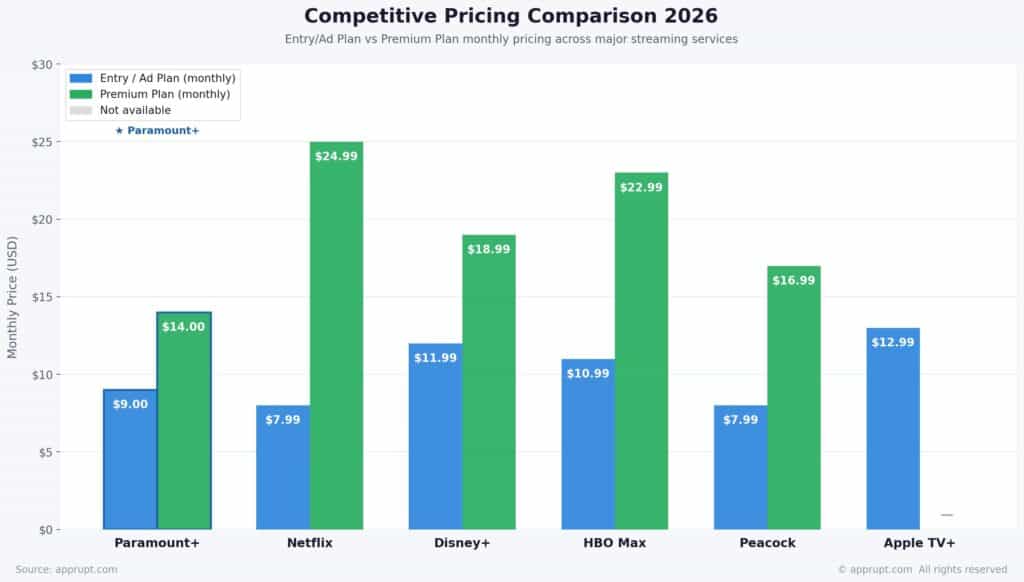
| Service | Entry/Ad Plan (monthly) | Premium Plan (monthly) |
| Paramount+ | $9.00 | $14.00 |
| Netflix | $7.99 | $24.99 |
| Disney+ | $11.99 | $18.99 |
| HBO Max | $10.99 | $22.99 |
| Peacock | $7.99 | $16.99 |
| Apple TV+ | $12.99 (no ads) | — |
Source
Paramount+ remains competitively priced relative to peers, with its $14 Premium tier significantly below HBO Max ($22.99) and Netflix ($24.99).
Content Strategy and Investments
2026 Content Spending
Under David Ellison’s leadership, Paramount committed to incremental programming investments exceeding $1.5 billion in 2026. This budget covers four pillars:
- UFC: A 7-year, $7.7 billion exclusive rights agreement making Paramount+ the home of all live UFC numbered events and Fight Nights in the US, Latin America, and select bouts in Australia. UFC 324 in January 2026 became the platform’s biggest-ever exclusive live event, reaching approximately 7 million US and Latin American households.
- South Park: A 5-year, $1.5 billion partnership with Matt Stone and Trey Parker — cited as the #1 driver of subscriber acquisition in Q3 2025.
- Originals slate: Upcoming series include Marshals, The Madison, The Agency Season 2, Star Trek: Strange New Worlds, Lioness, Tulsa King Season 3, and new titles from A24 (Discretion), plus third-party acquisitions.
- Film expansion: Ramping from 8 releases in 2025 to 15+ films in 2026, including Scream 7, PAW Patrol: The Dino Movie, Street Fighter, and Sonic the Hedgehog 4 in development.
Pluto TV Integration
Pluto TV, Paramount’s free ad-supported streaming service, continues to serve as both a standalone ad revenue generator and a subscriber funnel to Paramount+. The service reached 80+ million monthly active users globally in 2023 and has continued growing viewing hours since. A unified technology stack for Paramount+ and Pluto TV is targeted for mid-2026 launch, enabling cross-promotion, shared identity, and simplified user upgrades between free and paid tiers.
Demographics and Market Position
User Demographics
Paramount+’s audience spans three primary segments:
| Segment | Age Range | Income Profile | Key Content Drivers |
| Premium Drama Enthusiasts | 35–65 | $90K+ HHI, male-skewing | Yellowstone franchise, Showtime originals |
| Family & Animation | All ages (households with children <12) | All income levels | Nickelodeon ecosystem, PAW Patrol, SpongeBob |
| Value-Conscious Streamers | 18–34 | Mixed income | Ad-supported tier, Walmart+ bundle |
The Taylor Sheridan Universe on Paramount+ — including Yellowstone, 1883, Tulsa King, and Lioness — drove a reported 35% subscriber surge from the core adult drama audience.
US Market Share
Paramount+ holds 9% of the US SVOD market, placing it sixth among major streaming platforms behind Amazon Prime Video (22%), Netflix (21%), HBO Max (13%), Disney+ (12%), and Hulu (11%).
Global Availability
Paramount+ is available in approximately 45+ countries across North America, Latin America, Europe, Asia-Pacific, Africa, and the Middle East. European distribution is split between direct Paramount+ apps (UK, Ireland, Italy, Germany, France, Austria, Switzerland) and the SkyShowtime joint venture with Comcast (covering the Nordics, Central/Eastern Europe, Spain, Portugal, and the Netherlands).
2026 Outlook
Subscriber Projections
Paramount expects “only modestly higher” total paid Paramount+ subscribers in 2026 compared to 2025, due to the strategic exit of 4–5 million hard bundle subscribers with “unattractive economics” that accounted for less than 2% of Paramount+ revenue. Stripping out these exits, underlying subscriber growth is expected to accelerate year-over-year.
The company forecasts total 2026 revenue of $30 billion (4% year-over-year growth), with DTC as the primary driver through increases in both subscription and advertising revenue. Adjusted EBITDA is projected at $3.8 billion, representing a 12.7% margin.
Technology Transformation
A central pillar of the 2026 strategy is unifying Paramount’s fragmented tech infrastructure. Currently, Paramount+, Pluto TV, and BET+ operate on separate technology stacks and two different cloud platforms — meaning users cannot even be upgraded from Pluto to Paramount+ within the same system. The migration to a unified stack, including Oracle Fusion as the company-wide ERP system, is targeted for mid-2026 completion.
The Paramount-WBD Merger: Beyond 2026
Deal Structure
On February 27, 2026, Paramount formally agreed to acquire Warner Bros. Discovery for $31 per share in an all-cash transaction valued at $110 billion in enterprise value ($81 billion in equity value). The deal was funded by $47 billion in equity from the Ellison family and RedBird Capital Partners, plus $54 billion in debt commitments from Bank of America, Citigroup, and Apollo Global Management.
Paramount won the bidding war after Netflix declined to match Paramount’s latest offer; Netflix had bid $82.7 billion for WBD’s studio and streaming assets only, excluding cable networks. The transaction is expected to close in Q3 2026, subject to regulatory approvals and WBD shareholder vote.
Combined Streaming Platform
CEO David Ellison confirmed on March 2, 2026, that Paramount+ and HBO Max will be merged into a single streaming service post-acquisition. The combined entity would have approximately 210 million direct-to-consumer subscribers globally — 79 million from Paramount+ and 131.6 million from WBD.
However, meaningful subscriber overlap exists. Research firm Antenna estimates that in the US, approximately 7.6 million people subscribe to both services — representing 27.9% of HBO Max’s US subscriber base and 21.1% of Paramount+’s. After deducting overlap, the combined US paid subscriber base would be approximately 55.3 million.
Ellison stated that “HBO should stay HBO,” signaling that the HBO brand will maintain editorial independence within the merged platform. The combined content library would span HBO, Warner Bros., DC, Paramount Pictures, CBS, Showtime, Nickelodeon, UFC, NFL, NBA, NHL, MLB, NASCAR, and March Madness.
Financial Projections
The combined Paramount-WBD entity is projected to generate $69 billion in pro-forma revenue and $18 billion in EBITDA. Paramount expects over $6 billion in cost synergies driven by technology integration, corporate efficiencies, procurement savings, and real estate optimization. Net debt for the combined entity is projected at approximately $79 billion.
Regulatory Pathway
European Union antitrust approval is expected without significant hurdles, with any required divestments anticipated to be minimal. However, California Attorney General Rob Bonta has indicated the state will conduct a thorough review of the merger. WBD shareholder voting is anticipated in early spring 2026.
Streaming Industry Landscape
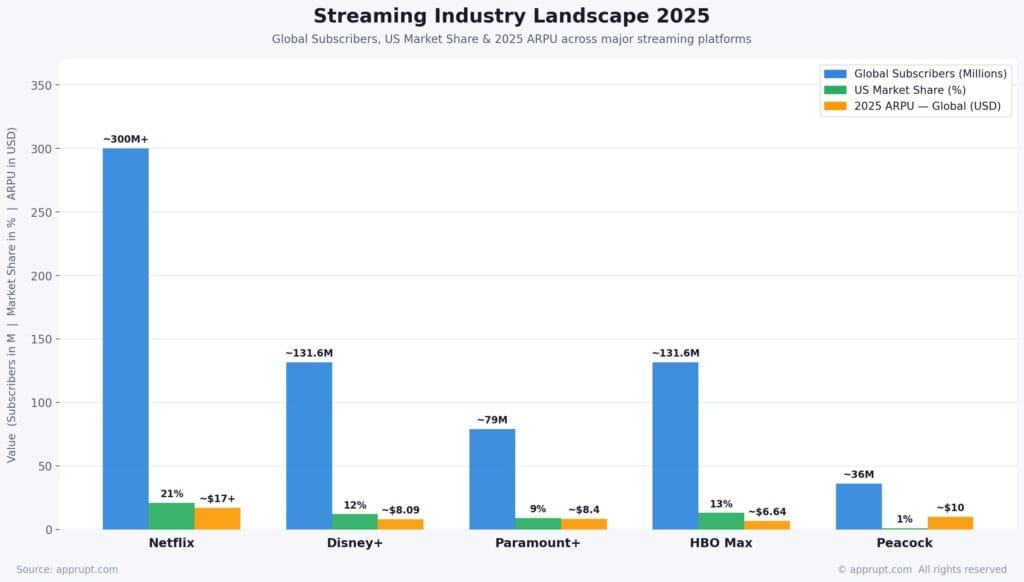
| Platform | Global Subscribers | US Market Share | 2025 ARPU (global) |
| Netflix | ~300M+ (stopped reporting) | 21% | ~$17+ |
| Disney+ | ~131.6M | 12% | $8.09 (domestic) |
| Paramount+ | 79M | 9% | $8.40 |
| HBO Max | 131.6M | 13% | $6.64 |
| Peacock | ~36M | 1% | ~$10 |
Industry-wide content spending is expected to exceed $100 billion in 2026, with Disney projecting $24 billion, Netflix approximately $18 billion, and Paramount adding $1.5 billion incrementally. The streaming wars are entering a consolidation phase, with the Paramount-WBD deal representing the most significant structural shift since the original launch of these platforms.
Key Takeaways
- 79 million paid subscribers as of Q4 2025, effectively flat year-over-year after bundle exits and methodology changes, but with underlying growth accelerating.
- DTC profitability achieved for the first time in 2025, with further improvement expected in 2026.
- ARPU growth outpacing subscriber growth at 10–11% year-over-year, driven by price increases and the exit of low-value bundles.
- $1.5 billion incremental content investment in 2026, anchored by UFC, South Park, and an expanded film slate of 15+ titles.
- $110 billion WBD acquisition will create a ~210 million subscriber streaming entity, merging Paramount+ and HBO Max into a single platform positioned as the #2 global streaming service.
- $30 billion total revenue projected for 2026, with $3.8 billion in adjusted EBITDA.
- $6 billion in synergies expected from the WBD combination, with closing anticipated in Q3 2026.
